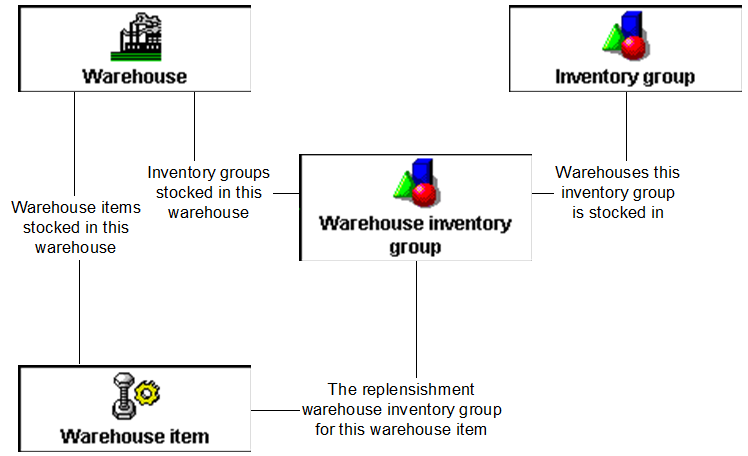
Concepts Tasks Settings Setting up Consignment Support for a Supplier and Resources Contents Setting up the Consigned Usage Not Invoiced Account Defining a Consignment Agreement for a Supplier Creating a Consignment Inventory Group for a Supplier Linking a Consignment Inventory Group to an Existing Warehouse Defining Consignment Resources and Prices for a Supplier Setting the Consignment Inventory Group for a Warehouse Item To track consignment inventory in the system, you must set up consignment inventory groups and warehouses, suppliers, and consignment supplier resources and warehouse items. If you have not already done so, you should also do the following: • Set up an account for consigned inventory usage that is not invoiced (CNI). See Setting up the Consigned Usage Not Invoiced Account. • Create material adjustment reasons for consignment adjustments. See **Setting up Material Adjustment Reasons. Warehouses A warehouse is a location that stores and tracks warehouse items. Usually, there is one APM warehouse for each controlled inventory location in your enterprise. Inventory Groups An inventory group allows you to define specific information about a group of items in inventory. You can indicate that items are either owned by your organization or consignment inventory. For consignment inventory groups, you must identify the consigning supplier. You must have at least one inventory group in the system, typically, the group for your regular, owned inventory. This inventory group is used to track inventory purchased under normal purchasing agreements; that is, inventory purchased at the time of receipt. To track consignment inventory, you must also create an inventory group for each supplier with whom you have a consignment agreement. Inventory groups are not used on their own but must be linked to warehouses to create warehouse inventory groups. Warehouse Inventory Groups A warehouse inventory group specifies a group of items contained within a particular warehouse. Each warehouse can have one or more warehouse inventory groups. It is the warehouse inventory group that most users work with on a day-to-day basis. The name of the warehouse inventory group is made up of a combination of the warehouse name and the name of the linked inventory group. The inventory group allows you to indicate that the warehouse items are either owned by your organization or are consignment inventory. Each supplier with whom you have a consignment agreement has its own inventory group. The following diagram shows the relationships between the warehouse, inventory group, and warehouse inventory group objects. In the system, warehouse items are stocked in warehouses; however, for replenishment purposes, each warehouse item must refer to a warehouse inventory group. It is this reference that determines whether the item is part of consignment or regular inventory. Setting Up Consignment Inventory for a Supplier and Resources You must perform the following steps to track consignment inventory for a supplier: 1. Define a consignment agreement for the supplier. Defining a consignment agreement tells the system that the supplier can be used for consignment inventory. See Defining a Consignment Agreement for a Supplier. 2. Create a consignment inventory group for the supplier. Each supplier that has consignment inventory must have its own inventory group. See Creating a Consignment Inventory Group for a Supplier. 3. Link the consignment inventory group to a warehouse. Each consignment inventory group must be linked to a warehouse. You can set up warehouses that are only used for consignment inventory or that are mixed (have both consignment and regular inventory). You can either link the inventory group to an existing warehouse or create a new warehouse for the supplier’s consignment inventory. See either Linking a Consignment Inventory Group to an Existing Warehouse or **Setting up Warehouses. 4. Define which resources the supplier has on consignment and the consignment price for each resource. Each resource that is supplied on consignment must be defined as such and must have a consignment price. See Defining Consignment Resources and Prices for a Supplier. 5. Set the consignment inventory group for each resource’s warehouse items. Each resource that is supplied on consignment must have a warehouse inventory group setting for replenishment purposes. See Setting the Consignment Inventory Group for a Warehouse Item.