Repairing Failed Units Using the Internal or On-site Repair Process

Contents
You can use work orders to plan and track internal repairs. All of the standard work order features, including planning, costing, scheduling, reporting activity, and closing can be used with repair work orders.
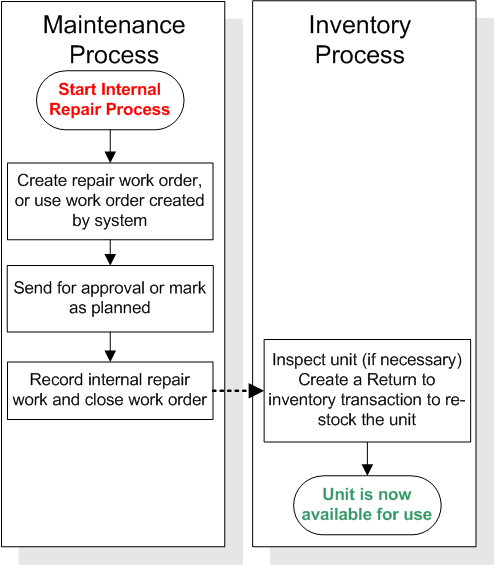
The following steps outline the internal repair process both for serialized units that are linked to assets and for units that are not linked. The process shown starts from the point where the unit swap has been completed.
Follow the steps in this procedure to complete an internal repair. If necessary, follow the links for more detailed instructions on any step. The statuses of the units are shown. Statuses are the same for units linked to assets and units that are not linked, unless otherwise indicated.
This topic assumes that you have already replaced (swapped) the failed unit. If you have not yet completed the swap, please see Swapping a Repairable Spare.

To Repair a Unit Internally

1.
If necessary, change the status of the of the unit to Repair On Site using the Move to Repair Shop method.
Note: When repairing a unit not linked to an asset internally, there is no visibility of the repair work order from the unit. Therefore, the repair work order will not appear on the Move to Repair Shop dialog. If you need to have visibility of repair work orders for internal repairs, you will need to link the units to assets.
Please see Moving a Serialized Unit to the Repair Shop.
2.
3.
For units not linked to assets, no status changes occur.
For units linked to component assets, closing the work order may update the status of the repaired unit. You can tell the system that the status of the failed unit should change once the work is complete. You can set this on the Asset Status Change tab of the work order task. Or, you can set the status change on the Work Order Close dialog. For example, after the unit is repaired you may want to change its status to ‘Awaiting Restock’.
Please see Closing a Repair Work Order Task.
4.
Please see Returning Serialized Inventory Units to Inventory.