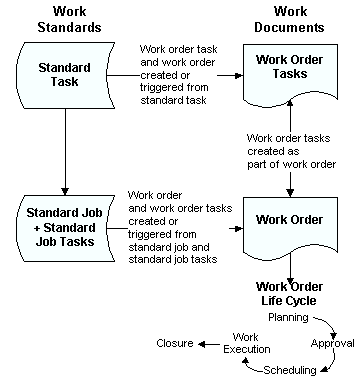
Concepts Tasks Settings Work Standards You can use APM to set up standards for work that your organization performs repeatedly. In APM, these work standards are called standard tasks, standard jobs, and preventive maintenance routes. This set of pre-planned work is an essential part of your asset reliability program. This section explains these work standards. Standard tasks and standard jobs can be created and updated using templates. For more information, see Work Templates. Standard Tasks A standard task is a plan for maintenance work that is performed repeatedly on a piece of equipment over the course of its lifetime. The work is typically one of the following tasks: • Inspection task for collecting readings for condition-based or failure-finding indicators with similar search criteria (for example, trade, frequency, or operating condition) • Corrective task to identify the work required to restore an asset’s alarm condition to a normal state. These tasks are candidates when users acknowledge alarms • Scheduled restoration or discard task to repair, replacement, or clean an asset at a defined frequency When the work needs to be performed, a work order task is generated from the standard task. The standard task contains all of the information required to create a work order task. This includes the asset to work on, the resources required to perform the task, the manually collected indicators to be read, and the procedures and documents appropriate to the performance of the task. In some situations, for example, when AssetWise Enterprise Interoperability (AWEIS) is being used to exchange data with a CMMS, checksheets and mobile activities can be generated from standard tasks on a regular basis, without the need for work orders. This is useful in integrated environments where it is not convenient to generate work orders in the CMMS. A standard task can be based on a task template or created from scratch. When based on a task template, the bulk of the task’s definition originates from the task template. Changes to its task template are applied to the standard task. This provides an easy method of maintaining common task definitions across similar assets. Standard tasks are independent of each other, and each standard task can be included on one or more standard jobs. TOP Standard Jobs A standard job is a collection of standard tasks for one or more assets. For example, you might create a standard job for a vehicle that includes standard tasks such as changing the oil, inspecting the brakes, and rotating the tires. The main purpose of a standard job is to group standard tasks to simplify the creation of work orders. When a standard job is used to create a work order, APM uses the job’s standard tasks to create the work order’s tasks. You can add triggering rules to a standard job so that work orders are triggered automatically. Standard jobs can be used to acknowledge indicator alarms and warnings. You can also manually trigger a standard job to create a work order at any time. Note: If the standard job has an open work order that was automatically triggered based on an indicator, it cannot be manually triggered. A standard job can be based on a job template or created from scratch. When based on a job template, the job’s list of tasks originates with the list of tasks on the job template. You can include triggering rules on the standard job that define when the work is to be done. When the conditions of a triggering rule are met, APM creates a work order from the standard job. Triggering rules can be based on time intervals or on the state of asset indicators. Standard jobs can be set up so that work orders generated from a standard job are automatically scheduled. Automatic scheduling reduces the effort required to develop your maintenance schedules. You can set up automatic scheduling both for maintenance groups that use simple scheduling and those that use availability scheduling. TOP Preventive Maintenance Routes A preventive maintenance (PM) route is a type of standard job that consists of a series of similar standard tasks performed on a number of similar assets. For example, you might create a PM route to perform vibration analysis on a number of assets. PM routes differ from other standard jobs in two ways: • A PM route tends to be made up of standard tasks that are the same or very similar (such as pump vibration analysis). Other standard jobs tend to have a collection of different types of tasks (such as change oil, inspect brakes, rotate tires). • A PM route usually has tasks for a large number of assets with no hierarchical relationship to each other. Because PM routes apply to many pieces of equipment rather than just one, we recommend that all PM routes be included in the reliability program for an organizational asset in your hierarchy, such as a site or a department. If you set up a common location for all routes, users can find this type of work quickly and easily. TOP Relationship of Work Standards to Work Orders and Tasks You can create work order tasks from standard tasks and work orders from standard jobs. When you create a work order task from a standard task, APM automatically puts the task on a new work order. When you create a work order from a standard job, APM automatically creates a work order task for each standard task on the standard job. TOP