|
Setting Options and Work Order Rules for a Standard Job
For each standard job, you can set options and rules that control the behavior of the work orders created from the job. This includes approval and scheduling options and rules for whether or not users are allowed to modify the work orders created from the job.To Set the Job’s Work Order Options and Rules
3.
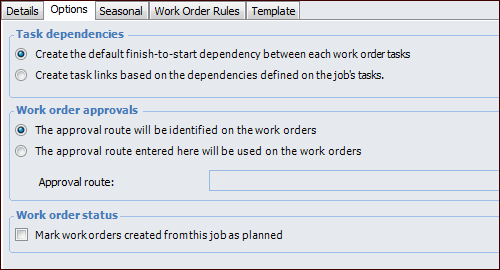
• Create the default finish-to-start dependency between each work order task – When a work order is created from this job, the tasks will have the standard Finish-to-start dependencies
• Create task links based on the dependencies defined on the job’s tasks – Select this option to allow the creation of dependencies on the job’s tasks. When a work order is created from this job, the job task dependencies will be used. If no dependencies are created on the job, none will be included on the job’s work orders.
6. If work orders do not require approval, you can have new work orders automatically marked as planned. Select Mark work orders created from this job as planned.
7. Select the Work Order Rules tab.
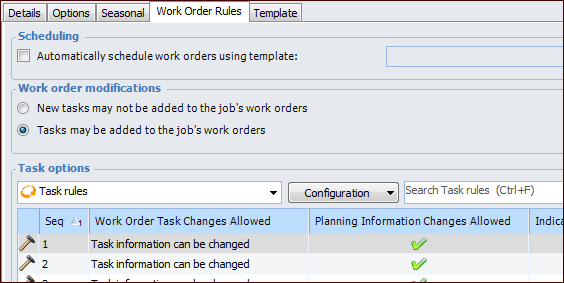
8. You can have the system automatically schedule all work orders that are created from this job. To do this, select Automatically schedule work orders using template. Select a Schedule template. When a work order is created from the job, the system looks for an open schedule based on the schedule template. If one exists, the work order is added to the schedule. If one doesn’t exist, the system creates a new schedule.
• New tasks may not be added to this job’s work orders. When a work order is created from this standard job, no tasks can be added to it.
• Tasks may be added to this job’s work orders. When a work order is created from this standard job, users can add tasks to them.
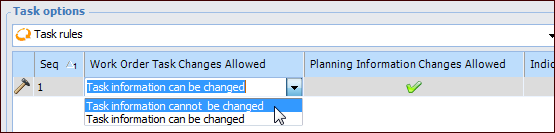
10. The Task options table lists the job’s tasks. For each task, the current rule is shown for whether information can be changed when the work order task is generated for the standard job. If you wish to change the rule, press F2. The task’s rule is open for editing: