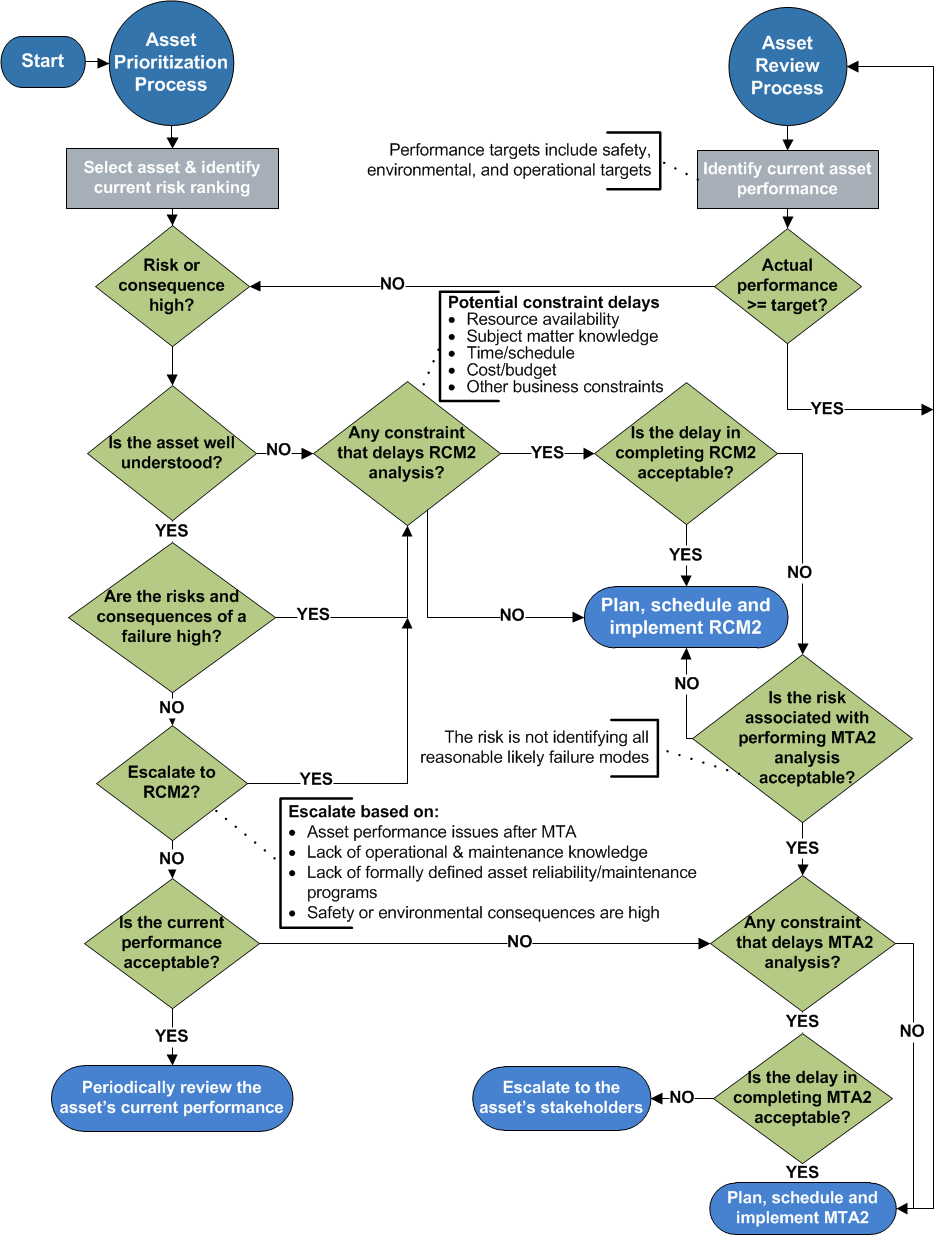
Concepts Tasks Settings Overview of Reliability Strategy Selection Reliability strategy selection (RSS) analysis applies a set of criteria to an asset to determine the most appropriate plan for improving its reliability. The analysis team uses the Reliability Strategy Selection questionnaire to perform, document, and review analyses of system-level assets. Possible strategies are to implement (or continue) basic care, perform maintenance task analysis, perform RCM2 analysis, or escalate the asset risk to stakeholders for further consideration and action. Strategy Selection in the Asset Reliability Process Reliability strategy selection is a component of the larger process of identifying and prioritizing asset improvement projects. The steps in this process are: 1. Define the asset hierarchy, which should be developed to the system level, at least, before you perform RSS analysis. 2. Perform asset prioritization analyses, which determine the assets’ relative risk and priority numbers. Whether performed using APM or by a third-party, the analysis determines the asset’s consequence priority: a value that describes the relative potential impact of an asset’s failure on the business goals of a company. This ranking allows you to identify and focus on those assets with the highest priority. The analysis also identifies the asset’s relative risk: a number that indicates the balance between the seriousness of failure consequences and the probability that failure will occur. For both the consequence priority and the relative risk, management must define thresholds for tolerability. Scores below the thresholds are considered tolerable. 3. Select the best reliability strategy for each asset, using its relative risk and consequence priority and the thresholds. Possible strategies are to implement (or continue) basic care, perform a maintenance task analysis, perform an RCM2 analysis, or escalate the asset risk to stakeholders. 4. Analyze risk versus effort to prioritize the strategies. The result is a list of reliability improvement projects sorted by relative importance. 5. Perform strategy development analysis, such as MTA2 or RCM2, for each asset that requires it. The Strategy Selection Process Reliability strategy selection starts with the list of assets sorted by relative risk, effort, and cost. Then select an asset and review the following: • Risk of failure and consequence severity • Operational and maintenance knowledge • Asset reliability program definition • Performance targets The following flowchart shows the decision logic used in the reliability strategy selection process. The outcome of the analysis is a list of assets that have been assigned appropriate reliability improvement strategies. APM provides an online questionnaire for performing strategy selection analyses. Using the asset’s consequence priority and relative risk, you can answer prompted questions to determine the recommended strategy. You can record information about the team members and notes about each decision. Team members can review the decisions and revise them if necessary. You can also print a report that lists the assets and their reliability strategies.