Browsing for Failure Modes for an RCM2 Analysis or Template

This topic explains how to copy failure modes into the analysis or template that you are working on.
Using the Copy Failure Modes wizard can involve as many as seven steps, depending on the type of copy you are doing:
1.
2.
3.
4.
5.
6.
7.
The steps appear at the bottom of each page. The current step is shown in blue. Any step that is not required for your copy is disabled.
Note: When a failure mode is copied, its status changes to Facilitation Incomplete in the target analysis.
Note: If you copy a failure mode from a site that uses a different currency, any monetary amounts defined on the action plan are converted to the asset’s site currency. If an exchange rate is not available, the amount is converted at par (for example, one U.S. dollar is equivalent to one Canadian dollar).
There are differences in the Copy Failure Mode wizard if you are copying from or to a template. The illustrations in the procedure show an analysis-to-analysis copy. Any differences in functionality for templates are explained where they occur.

To Browse for Failure Modes

1.
2.
Click the Tools menu, Failure Modes, and then Browse.
Tip: If functions have already been defined in the RCM2 analysis, you can also select the Facilitation view, Info Worksheet tab. Click the New list and then Browse.
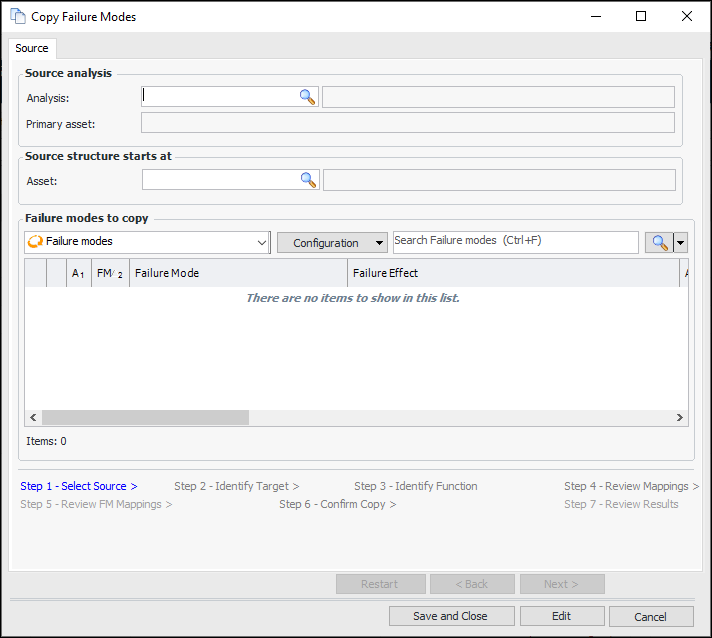
The Copy Failure Modes wizard appears showing the Select Source step.
3.
Click the browse icon () in the Analysis box to select the source analysis or template. The Strategy Development Analysis Selector dialog appears, displaying analyses appropriate for the target. Select an option from the configuration list to view a specific type of analysis.
Note: You can copy failure modes from an RCM2 analysis or template only.
4.
Select an analysis or template and click OK. The Failure modes to copy table displays the source’s failure modes. If the source is an analysis, the table also contains any failure modes assigned to child assets in the analysis. The primary asset is displayed as the start of the source asset structure. If the source is a template, the asset type is displayed.
5.
Tip: For quick copies (when you do not need to adjust the mapping options), click Finish when you have selected the source analysis and the functions. If the source is a template, select a target (next step) and then click Finish. The wizard performs the matching process and skips to the Confirm Selections page. Skip to step 18.
6.
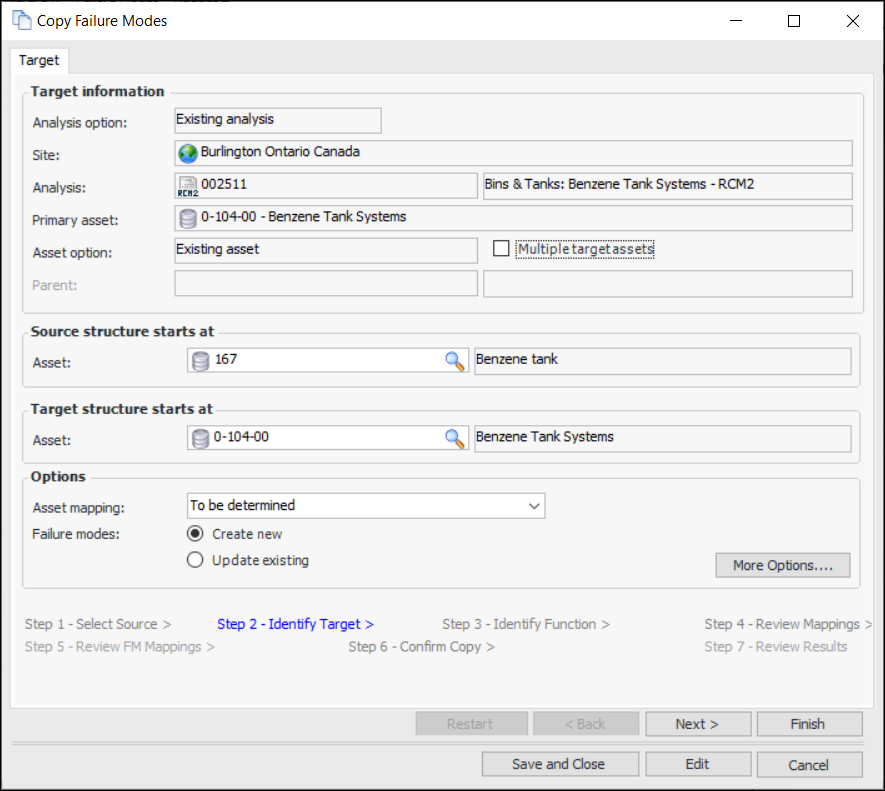
Click Next. The Identify Target step appears. This page differs depending on the characteristics of the source and target analyses.
In some cases, you might wish to change the source asset structure, target asset structure, or both. When the starting assets occupy parallel positions in their respective hierarchies, the mapping process is more likely to result in accurate matches.
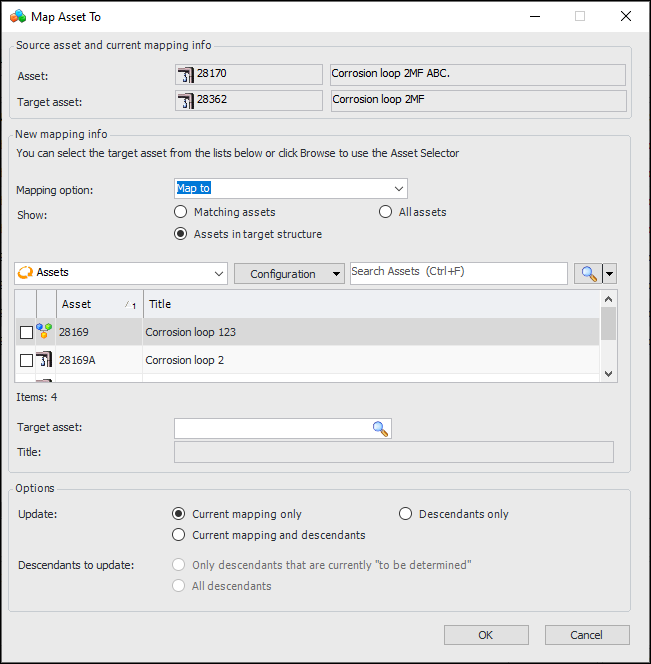
You can select Multiple target assets to display the analysis assets are listed in the Target asset structures table. For example:
You can select the target assets to use in the matching process.
If you are copying from an analysis to a template, only the Source structure starts at area is enabled. Skip to step 9.
 
7.
If the Asset mapping list is available, you can change the asset mapping that will be suggested if APM cannot identify a matching target. The options are:
Exclude – the source asset is excluded from the copy, as well as any failure modes, indicators, and standard tasks and jobs that refer to it
Map to primary target asset – the source asset is mapped to the target asset selected as the starting point for the structure
New – a copy of the source asset is created when the copy request is processed
Same – the source asset is mapped to itself
To be determined – you can select the mapping option later
8.
Create new – a copy of the failure mode is created when the copy request is processed
Update existing – the source failure modes’ properties are copied to the target failure modes
9.
To set additional mapping options, click More Options. The Options dialog appears. For information about using this dialog, see Setting Mapping Options for a Failure Mode Copy. Click Close when you are finished.
10.
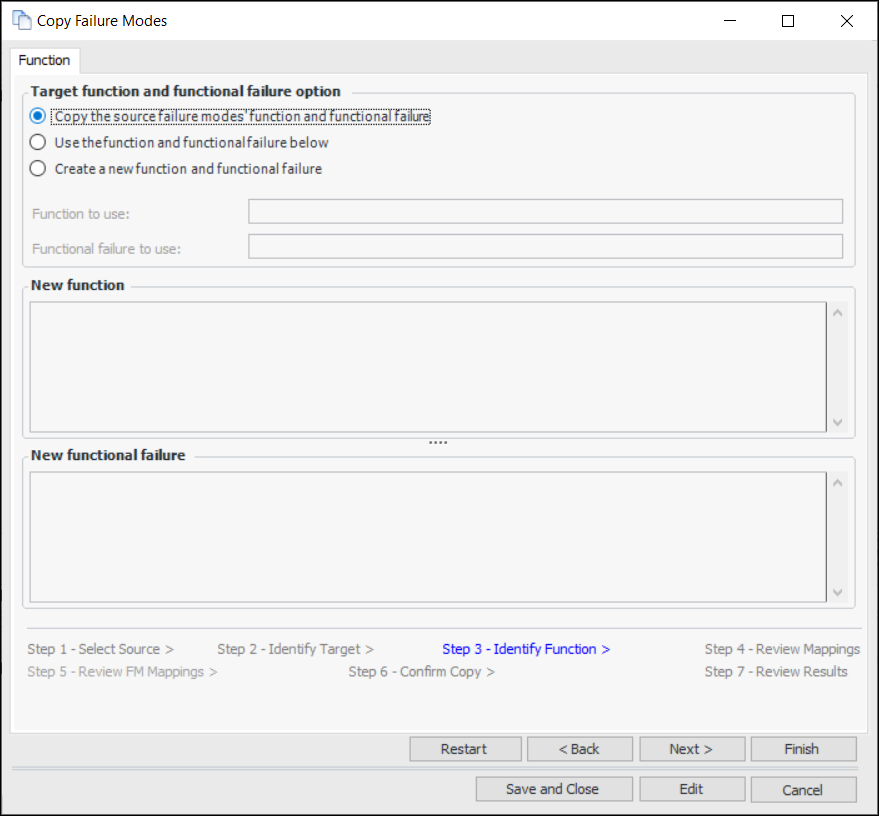
Click Next. The Identify Function step appears. For example:
11.
Copy the source failure modes’ function and functional failure – copies of the function and functional failure are created in the target analysis when the copy request is processed
Use the function and functional failure below – select the function and functional failure from the target analysis
Create a new function and functional failure – provide descriptions in the Function and Functional failure boxes
12.
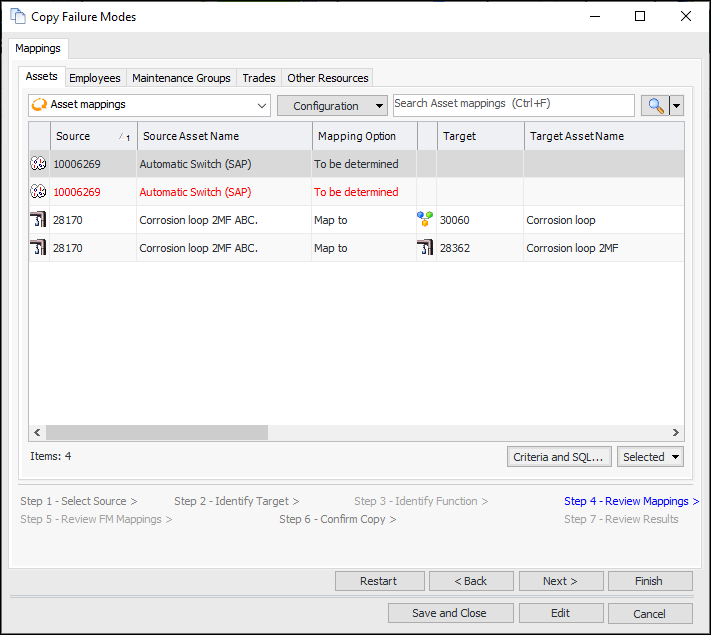
Click Next. The wizard matches objects as needed and presents the mappings for your review. For example:
Tip: To view information about a source object on any of the mapping tabs, right-click it and click Source. For example, the Source dialog that appears for an asset mapping contains tabs for the asset’s failure modes, indicators, work order tasks, jobs, and job tasks, as well as the corrective tasks, jobs, and job tasks for the indicators. You can also view information about any secondary action plans included in the failure modes.
13.
The Suggestion Origin column displays the method used for matching. The options are:
Previous match – the “Use results of previous copy” option is in effect
Suggested – the mapping is based on another criteria, for example, hierarchy level or attribute matching
Default – for assets, the source and target primary assets are automatically matched. For employees, maintenance groups, and trades, the source object is used as the target, provided that it is valid at the target site.
Manual – the user selected the mapping
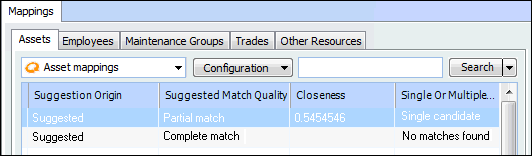
The Suggested Match Quality, Closeness, and Single Or Multiple Candidates columns show you the results of the smart mapping process. The following example shows that Trigram matching was used (the suggested match quality is “Partial match”), one partial match was found (single candidate), and a score of 0.5454546 was obtained. The candidate matches “Conveyor Belt” with “Conveyor”. An exact match has a closeness score of 1.0.
14.
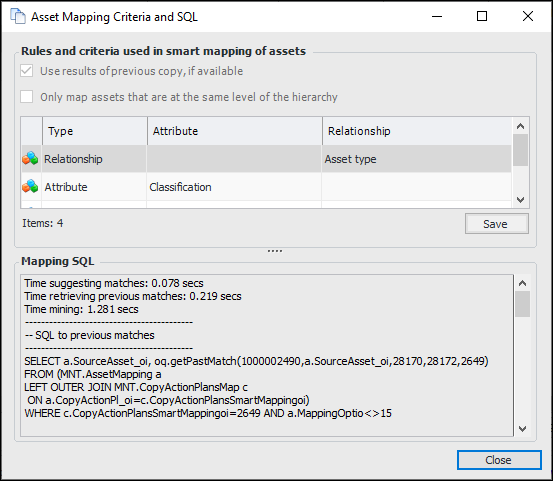
To view more information about the matching process, click Criteria and SQL. The Asset Mapping Criteria and SQL window appears. For example:
To see information about mappings for other objects, select their tabs and click Criteria and SQL.
15.
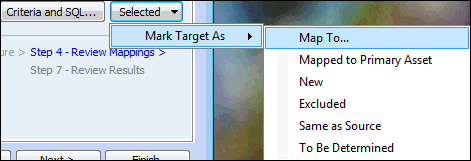
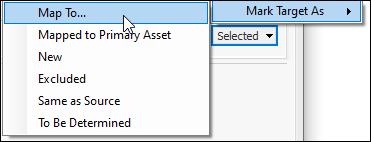
To make adjustments to a mapping, select it in the table, click Selected, Mark Target As, and one of the options. Here is an example of the list for asset mappings:
The options are:
Map Toselect this option to view the candidates and select another, if you wish. For more information, see Manually Changing an Asset Mapping.
Mapped to Primary Assetthe source asset is mapped to the target asset selected as the starting point for the structure
New a copy of the source object is created when the copy request is processed
Excludedthe source asset is excluded from the copy, as well as any failure modes, indicators, and standard tasks and jobs that refer to it
Same as Source the source object is mapped to itself
To Be Determined you can select the mapping option later
For employees, trades, and maintenance groups, the Mark as options are New, Same As Source, and To Be Determined.
Tip: You can also double-click a mapping to review the Asset Mapping dialog.
Note: If a mapping is marked as To be determined, the copy request cannot be processed. However, you can save and close it until you decide what to do with it. You can then re-open the request from a Copy Requests tab and finish defining and processing it. For more information, see Revisiting RCM2 Failure Mode Copy Requests.
16.
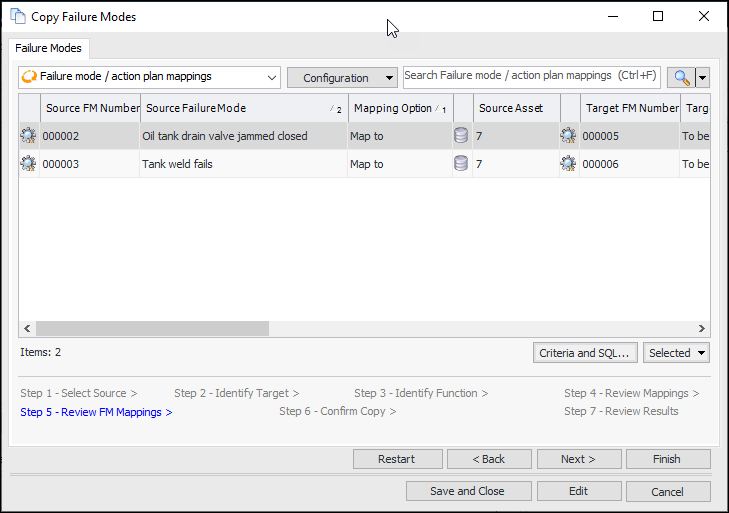
Click Next. If you are updating existing failure modes, the Review FM Mappings step appears.
Review the mappings before proceeding. To change a mapping, right-click it, click Mark As, and click one of the options:
New – the wizard creates a failure mode instead of updating the existing one
Excluded – the failure mode is not copied
To Be Determined – you can save the copy request and finish processing it later
17.
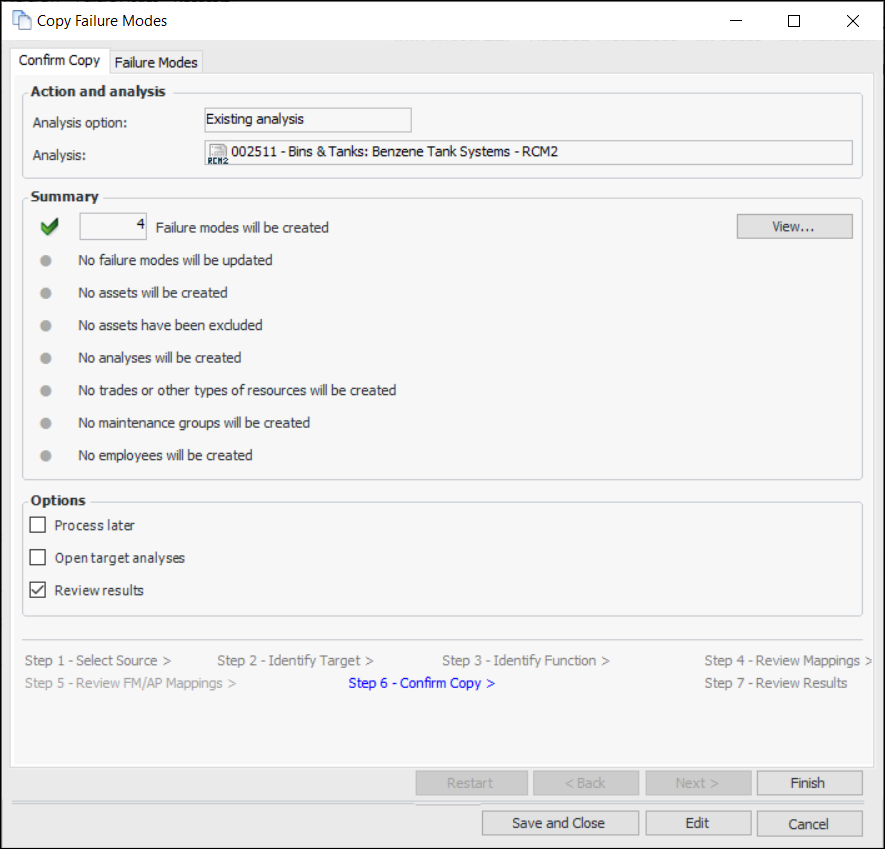
Click Next or Finish. The Confirm Copy step appears. For example:
18.
The Failure Modes tab shows information about the source failure modes. If you wish to remove a failure mode from the list, right-click it and click Remove. Click Back to make adjustments on previous pages.
19.
In the Options area, select the processing options:
20.
Click Process or Finish if Process later is selected. One of the following occurs:
If Process later is selected, a confirmation message appears. Click Yes to save the copy request to be completed later.
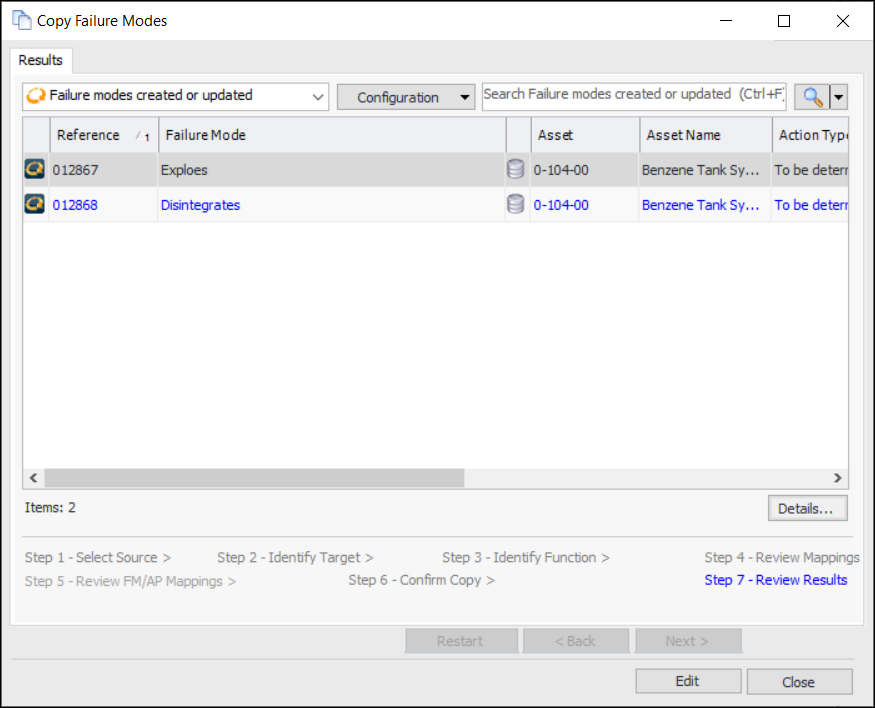
If processing has not been deferred, the copy is completed. If Review results is selected, the Review Results step appears. For example:
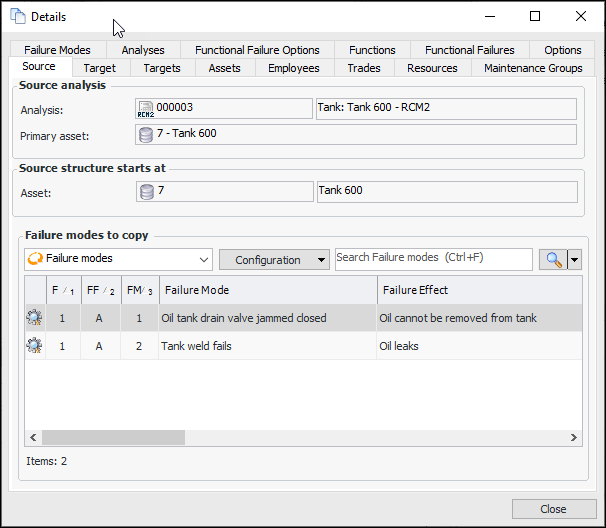
To view more information, click Details. The Details window displays information about the source and target asset structures, asset mappings, employees, trades, maintenance groups, failure modes, and so on. For example:
Click Close to return to the wizard.
When you are finished reviewing results, click Close. You can view the information again on the Copy Requests tab for the site or the analysis.
If Open target analyses is selected in the Confirm Selections step, the Strategy Development Analysis window appears.

Manually Changing an Asset Mapping
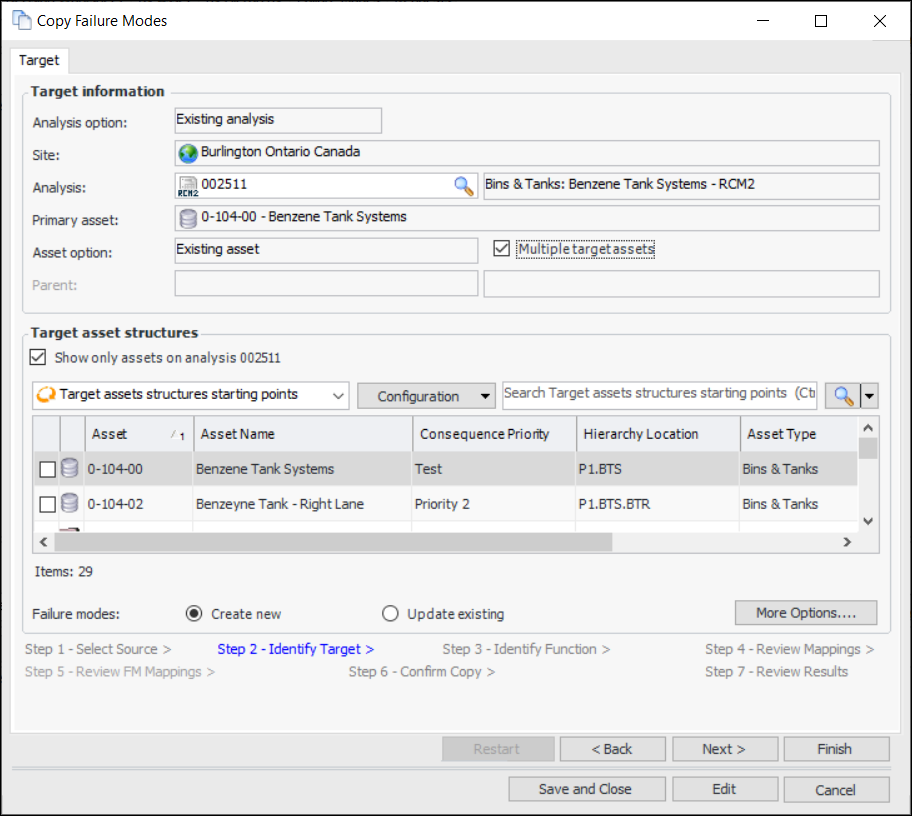
You can change an asset mapping manually in the Review Mappings step of the Copy Failure Modes wizard.
1.
Select the mapping in the Asset mappings table, click the Selected list, then Mark As and Map To.
The Map Asset To window appears.
2.
To change the mapping options, select an option in the Mapping option list. The options are:
Exclude – the source asset is excluded from the copy, as well as any failure modes, indicators, and standard tasks and jobs that refer to it
Map to – map to a matching asset
Map to primary target asset – the source asset is mapped to the target asset selected as the starting point for the structure
New – a copy of the source asset is created when the copy request is processed
Same – the source asset is mapped to itself
To be determined – you can select the mapping option later
3.
Matching assets – displays candidates identified during the original matching process
Assets in target structure – displays all assets in the target structure
All assets – displays all assets on the site
4.
Select the new target asset from the table or click Browse next to the Target box and select a target.
5.
Current mapping only – the default selection limits the update to the current mapping
Descendants only – only descendants of the target asset are remapped
Current mapping and descendants – both the current mapping and the descendants’ mappings are updated
6.
If you select to update descendants, the Descendants to update options are available:
Only descendants that are currently “to be determined” – only descendants that have not been mapped are updated
All descendants – descendants that have been mapped are also updated
7.
When you are finished, click OK to return to the Review FM Mappings step.