Overview of RCA

Root cause analysis is a methodology used to identify the causal factors for equipment failure. Its goal is to direct corrective measures at root causes to minimize the recurrence of problems. The RCA tools provided by APM incorporate both proactive and reactive approaches, allowing the analysis team to react to partial or full failures, as well as to investigate significant contributing causes to prevent failures.
This topic provides an overview of RCA concepts, the steps for performing root cause analysis using APM, and how failure evaluation works.

Proactive and Reactive Analyses

APM RCA supports two types of root cause analysis:

Performing RCA

Here are the stages of root cause analysis, along with links to topics that explain how to use APM to perform or document each step.
Note: Before you can perform root cause analysis, administrative settings must be defined to support it. For more information, see Setting up APM for RCA.
1.
Determine whether a failure or problem warrants investing resources in root cause analysis. To do this, identify the type, scope, and seriousness of failure consequences. The analysis team must also determine the severity of the problem and the probability of the failure reoccurring. APM calculates the criticality index using the consequences, severity, and probability of recurrence:
Criticality Index = Consequence Priority * Failure Severity * Probability of Recurrence
The value of the criticality index, in turn, determines whether RCA is required, recommended, or not required.
Based on the results of this evaluation, the team determines whether or not an RCA is required.
You can evaluate failures for RCA in APM from the failure record or the RCA. For more information, see:
2.
There are three ways to create a root cause analysis in APM:
For more information, see Creating a Root Cause Analysis.
As the analysis progresses, you can record and review comments, document team meetings, and review checklist items.
For more information, see:
3.
When analyzing problems, the team gathers information (for example, through record gathering, timely physical examination of the scene, and operator interviews), considers containment actions, reviews the processes involved, compares process information using tools such as trend graphs, histograms, yes-no tables, and comparison tables.
Using APM, you can review failure consequences and add failures if required. You can record the problem definition and review asset information. Attach evidence in the form of documents, photographs, and so on.
For more information, see Defining the Problem.
4.
The next step in the RCA process is to identify and sequence the possible and contributing causes of the problem. As the analysis team describes them, you can add causes to the RCA diagram, arrange them as needed, and add descriptions and verifications. The team analyzes the causes until the root causes are agreed upon. The end point of each branch in the diagram is either a root cause or an eliminated cause.
For more information, see Performing a Root Cause Analysis.
5.
An optional step is to evaluate causes in terms of immediate and basic causes and lack of control. For each cause classification, you can provide descriptions and categorize the underlying causal factors, such as substandard conditions or inadequate maintenance procedures.
For more information, see Identifying Cause Classifications.
6.
If your organization requires analyses to be approved, send the analysis to the first approver on the route. The approval process is usually initiated when root causes are identified and before corrective actions are implemented.
For more information, see Sending an RCA for Approval.
7.
The team then determines the causes for which a corrective action can be implemented to prevent the problem from occurring in the future. This might involve recording the consequences of mitigation actions and costs. You can create or request a failure mode analysis on a new or existing strategy development analysis. Action plans developed in the analysis can identify condition monitoring tasks (indicators), modifications and procedure changes, corrective tasks to be performed, and so on.
For more information, see Creating Solutions for Root Causes.
8.
When action plans have been implemented, you can review solutions, including their net benefits, compare mitigated and unmitigated consequences and benefits, view historical information about the RCA, and print RCA reports.
For more information:

RCA Recommendation Thresholds

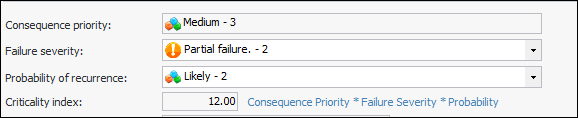
Using the Failure window’s RCA view or the RCA window’s Definition view, you can evaluate a failure’s suitability for root cause analysis, based on the failure’s criticality index. APM calculates the criticality index as follows:
Criticality Index = Consequence priority * Failure Severity * Probability of Recurrence
The value of the criticality index, in turn, determines whether RCA is required, recommended, or not required.

Consequence Priority

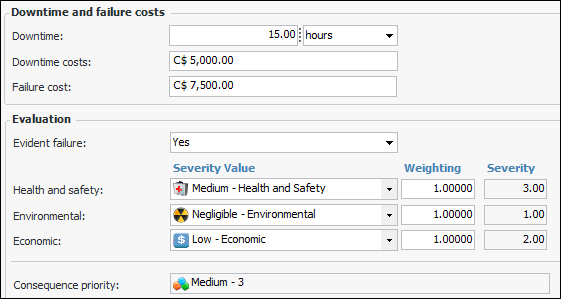
During the evaluation, the team specifies whether the failure is evident or hidden. Then they determine the failure’s consequence priority by selecting severity values for the health and safety, environmental, and economic consequences. For example:
Note: If the failure references a failure mode, severity values are copied from the failure mode’s risk analysis to the failure’s Consequences tab.
APM calculates the consequence priority by multiplying the severity values by their weighting factors and then applying a rule to the result. For example, the following rule could assign a consequence priority of “Medium”.
Any of(Environmental, Economic, Safety) Is equal to 3.00
Rules can also include the failure record’s downtime and failure costs. The larger the consequence priority number, the greater its priority.

Criticality Index

The criticality index is calculated by multiplying the numbers assigned to the consequence priority, failure severity, and probability of recurrence. For example:

Recommendation

The failure’s evident/hidden value and its criticality index determine the RCA recommendation.
The recommendation is determined by the position of the criticality index value in the recommendation thresholds.
Possible recommendations are:

RCA Recommendation Thresholds

For each of the consequences, specify the range of criticality indices for hidden and evident failures. The ranges work like this:
Failures that result in health and safety consequences typically have equal weight with environmental consequences. Hidden failures are given more attention than evident ones. Here is an example of recommendation thresholds.
2
10
4
10
2
10
4
10
2
6
4
8
1
10
10
12
The first set of thresholds that apply to the failure is used.
For information about setting up the thresholds, see Setting up RCA Recommendation Thresholds.