|
Performing Risk Analysis for RBI Failure Modes
After you have analyzed the failure modes, you can compare failure modes and identify the relative importance of addressing them. The Risk Assessment view in the Strategy Development Analysis window includes failure mode lists based on criticality, consequence priority, severity, and relative risk, as well as a risk plot, risk matrix, and lists of the evaluations. This view is also available for the asset.RBI analyses, typically for assets with Oil and Gas specifications, can use lookup tables and calculations to determine a failure mode’s probability of failure or consequence severity. For example, a health and safety evaluation could calculate the failure mode’s consequence ranking based on the toxicity index value assigned to the asset’s fluid type. For information about using these questionnaires, see Setting up Consequence Severity Evaluations to use Lookup Tables.
• For instructions on using the simpler evaluation with weighted severities, see Performing RBI Risk Analysis with Weighted Severities.Note: APM also provides a method of performing risk analysis on safety devices that protect equipment, people, and environments from events such as pressure build-up, fire, or equipment failure. Risk analysis is performed on one or more demand scenarios identified on the failure mode. For more information, see Performing RBI Demand Scenario Risk Analysis.Note: Before you can perform risk analysis, the severities, probabilities, confidence factors, and risk matrix entries must be set up in the site’s risk analysis settings. If you are using evaluation forms, they must also be set up. For more information, see Setting up APM for RBI Analysis.
1. To Evaluate the Probability of Failure – The probability of failure is the likelihood that the asset will fail due to the failure mode. You can determine the probability score using a questionnaire, selecting a value directly, or entering the estimated time between failure (ETBF). The options available to you depend on the analysis’ risk settings.
2. To Evaluate Economic Effects of Failure – The economic consequence of failure reflects the financial effect of the failure on assets and production. Labor and material costs associated with lost production and with repairing or replacing the damaged equipment are economic consequences. The options available to you depend on the risk analysis settings. You can use a questionnaire or select a value directly, depending on the analysis’ risk settings.
3. To Evaluate Health and Safety, Environmental, and Reputation Consequences – Equipment failure can cause hazards in the workplace and environmental damage. Examples are extreme temperatures, noxious fumes, and the release of liquids that cause pollution. Mitigating factors are considered when assessing health and safety and environmental consequences. Reputation consequences measure the impact that negative media attention has on an organization’s ability to operate in good faith. The levels of severity can also be associated with monetary costs. You can use questionnaires or select values directly, depending on the analysis’ risk settings.
4. To Assign a Detectability Value – When support for detectability is enabled in an analysis, the relative risk calculation becomes:
5. To Evaluate Confidence Factors – The confidence rating reflects the confidence that the inspector and materials or corrosion engineer have in current maintenance or inspection practices to contain the failure mode’s risk. The higher the value, the greater their confidence. The failure mode’s criticality rating, mediated by the confidence factor, results in an inspection factor, interval, strategy, or a combination.
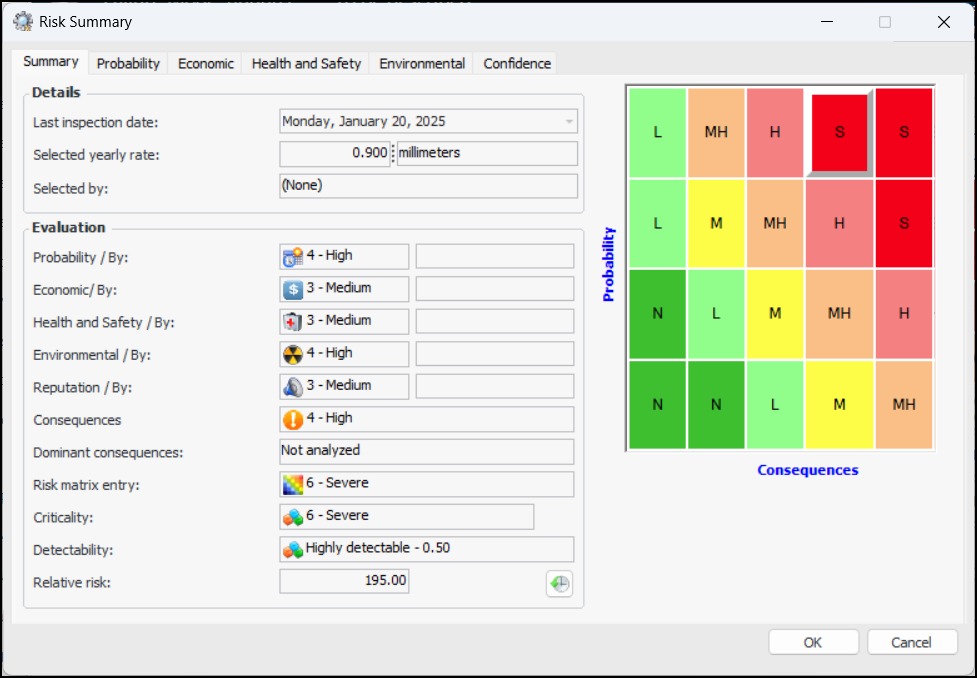
6. Viewing the Risk Analysis Summary – You can view the most recent evaluation results by clicking Summary on the Criticality tab. The Risk Summary dialog displays tabs for each of the questionnaires used in the analysis.Tip: You can export criticality evaluations for all the analysis’ failure modes to a Microsoft Excel® file. Then add data to the file and import it back into the analysis. For more information, see ......To Evaluate the Probability of Failure
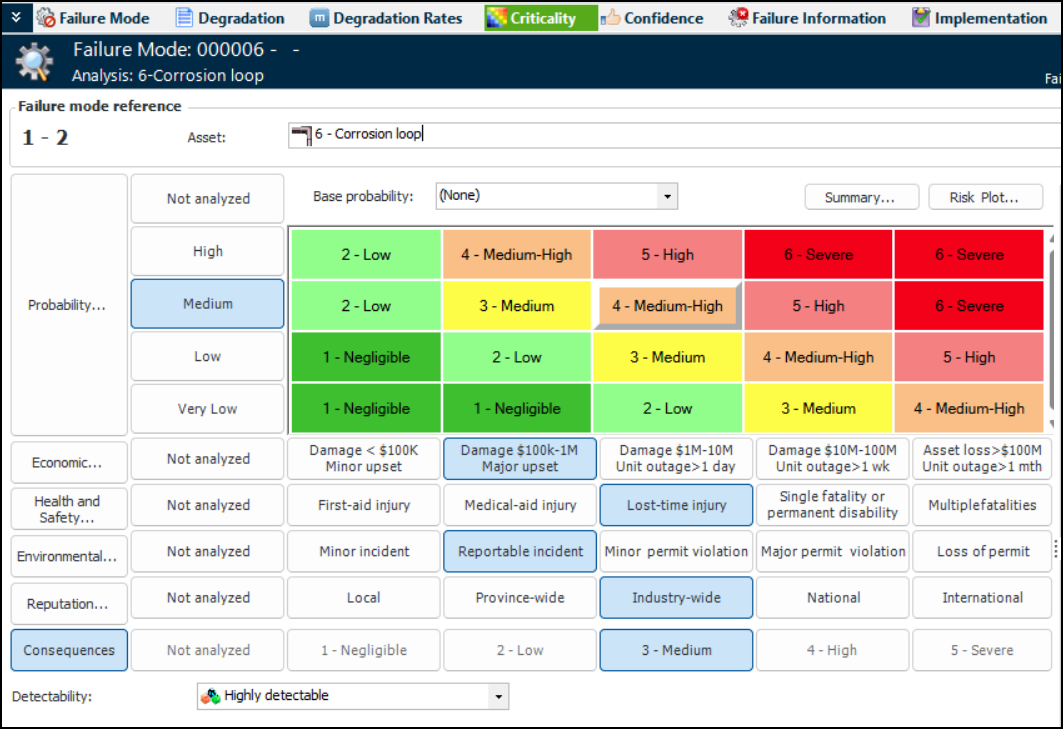
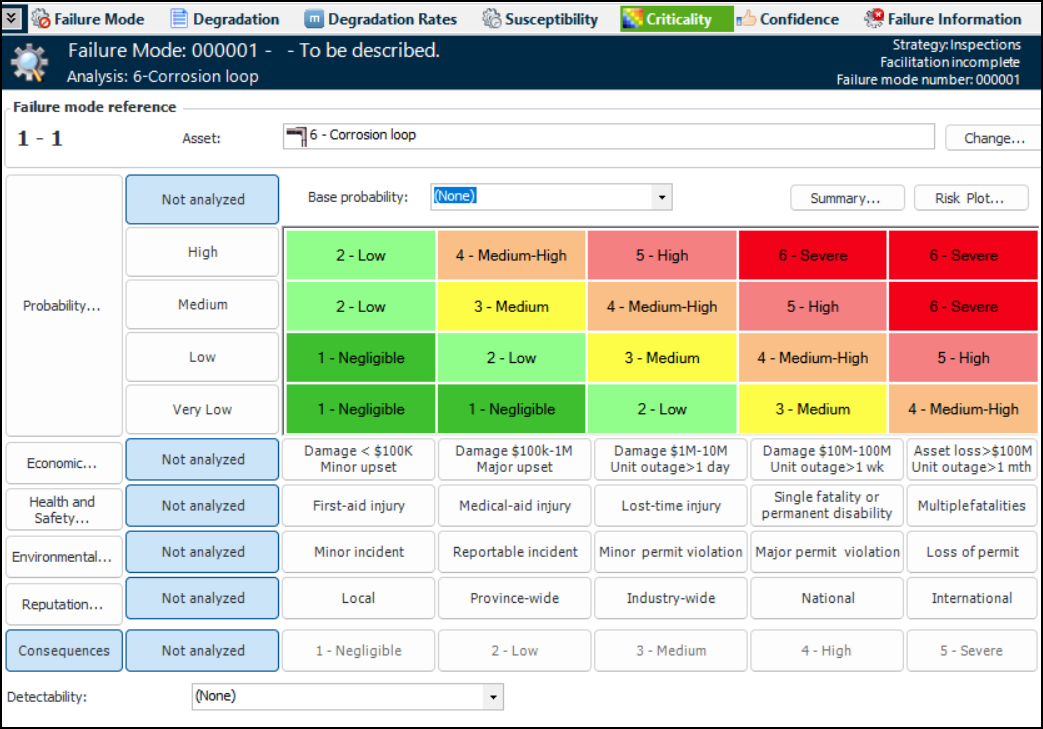
3. Select the Criticality view. For example:
4. If probability can be based on the team’s estimate of the time between failures without maintenance tasks, the Criticality view also displays the Estimated TBF without maintenance area:
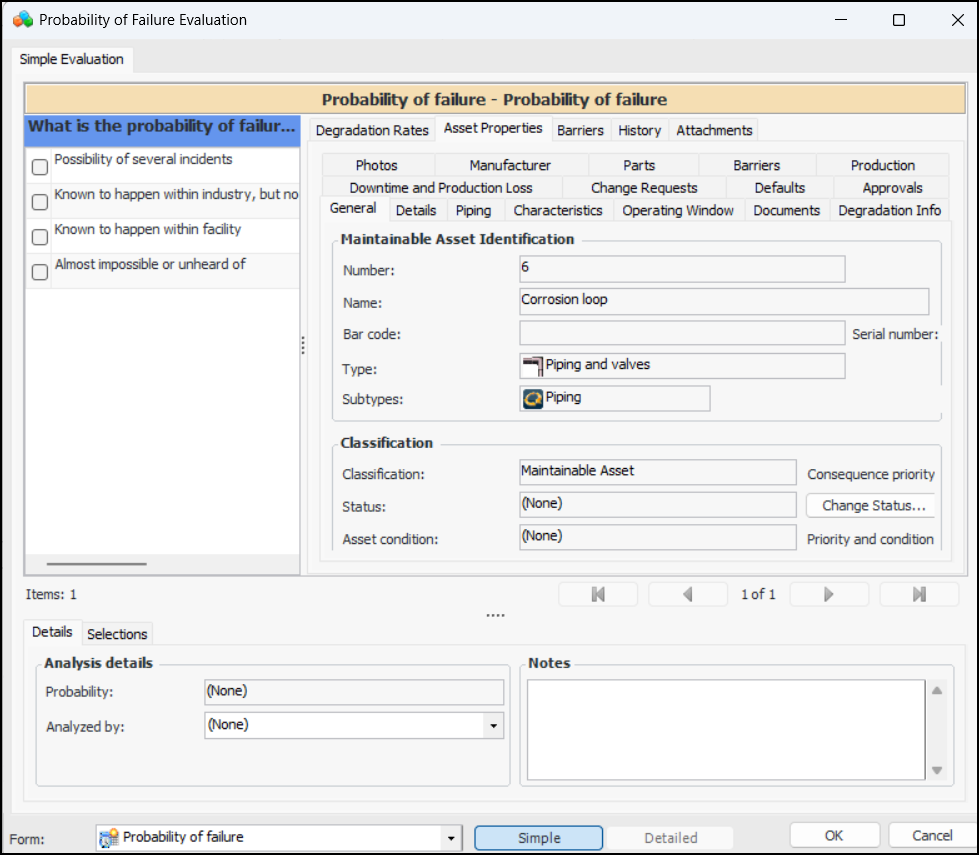
5. To use a questionnaire, click Probability. The Probability of Failure Evaluation appears. The evaluation types (Simple, Detailed), categories, and questions available to you depend on the form’s design and the asset properties. Here is an example of a simple evaluation:You can refer to the History and Barriers tabs for information to aid in the evaluation, for example, historical inspections, failures, and work.
6. Complete the evaluation, selecting options for each category, entering notes, and using the arrow buttons to move between categories. If different evaluation types have been defined in the form’s design, you can select Simple or Detailed, as required by the complexity of the failure mode that you are analyzing.As you move through the analysis, the Probability box displays the most severe probability value assigned to your selections. For example, if you select options for three categories, two of which have a result of “Negligible” and one with a result of “High”, the score for the evaluation as a whole will be “High”. This will be the probability used in the risk analysis.
7. In the Analyzed by list, select the team member performing the evaluation.
8. In the Notes box, you can provide additional information about the analysis. Notes are collected and available in several locations.
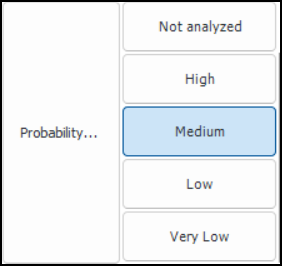
9. When you have completed the evaluation, click OK. The evaluation form closes and the result (for example, very high, high, medium, low, or negligible) is selected in the risk matrix. For example:To Evaluate Economic Effects of Failure
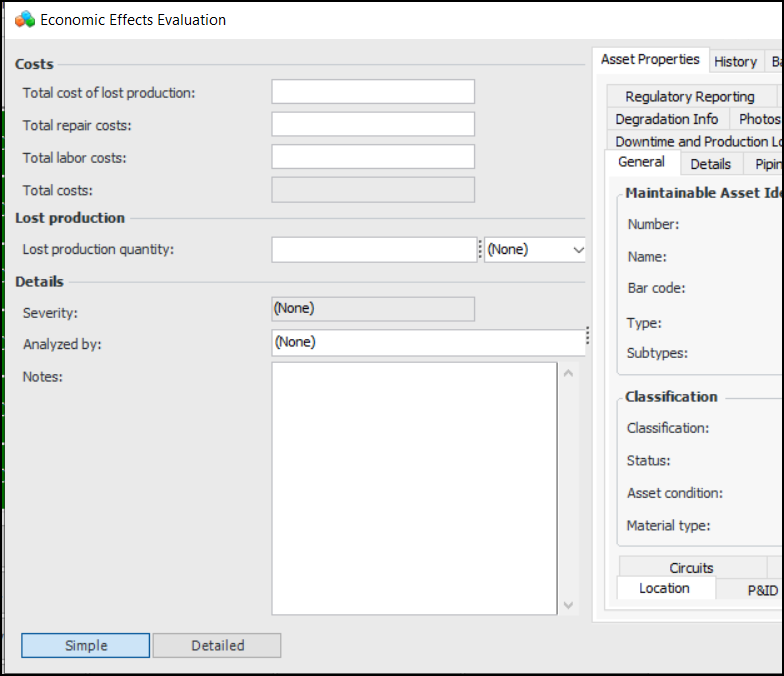
1. In the risk matrix, click Economic. The Economic Effects Evaluation form appears. For example:At any time, you can refer to the Asset Properties, History, Barriers, and Attachments tabs for detailed information about the asset.
2.
As you enter amounts in the Total cost of lost production, Total repair costs, and Total labor costs boxes, APM calculates the total amount and the severity.
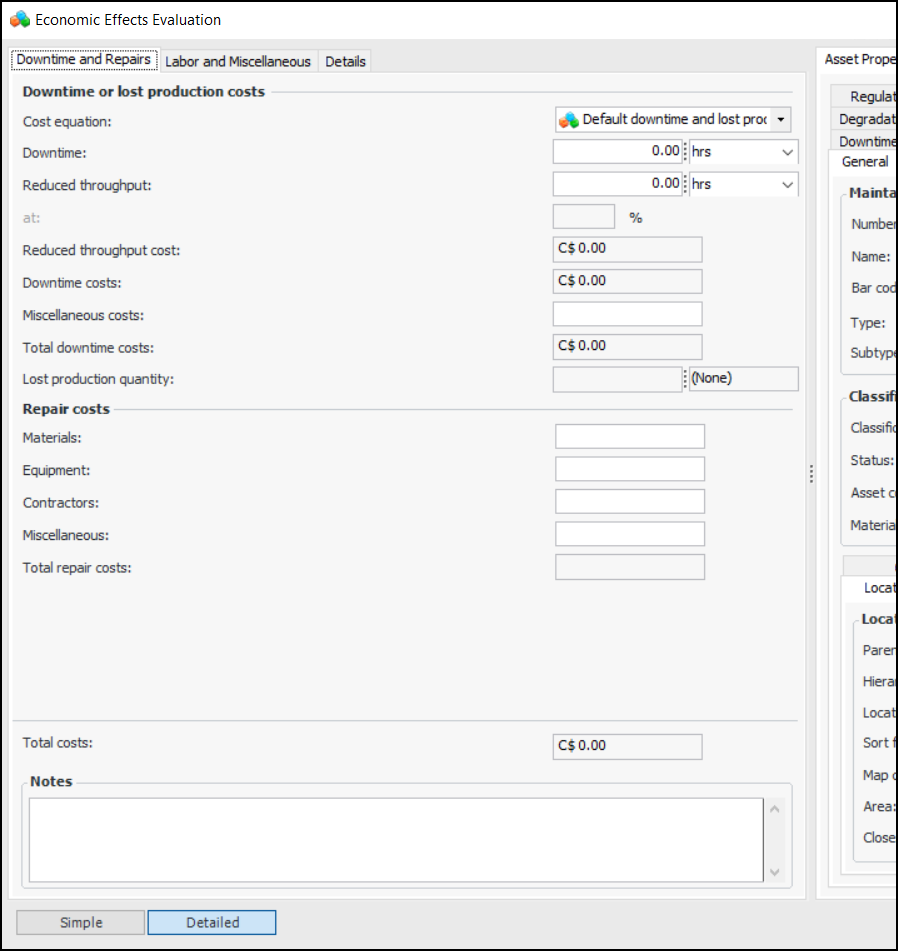
3. To perform a more detailed evaluation, click Detailed. Here is an example of a detailed form:As information is added to the form, APM calculates the total costs for the failure and displays the Severity score. All monetary amounts are shown in the site’s currency.
Tip: Select the Asset Properties tab and then the Downtime and Production Loss tab to view the production loss cost equation.
The total is calculated by summing all of the amounts in the Lost production costs area.
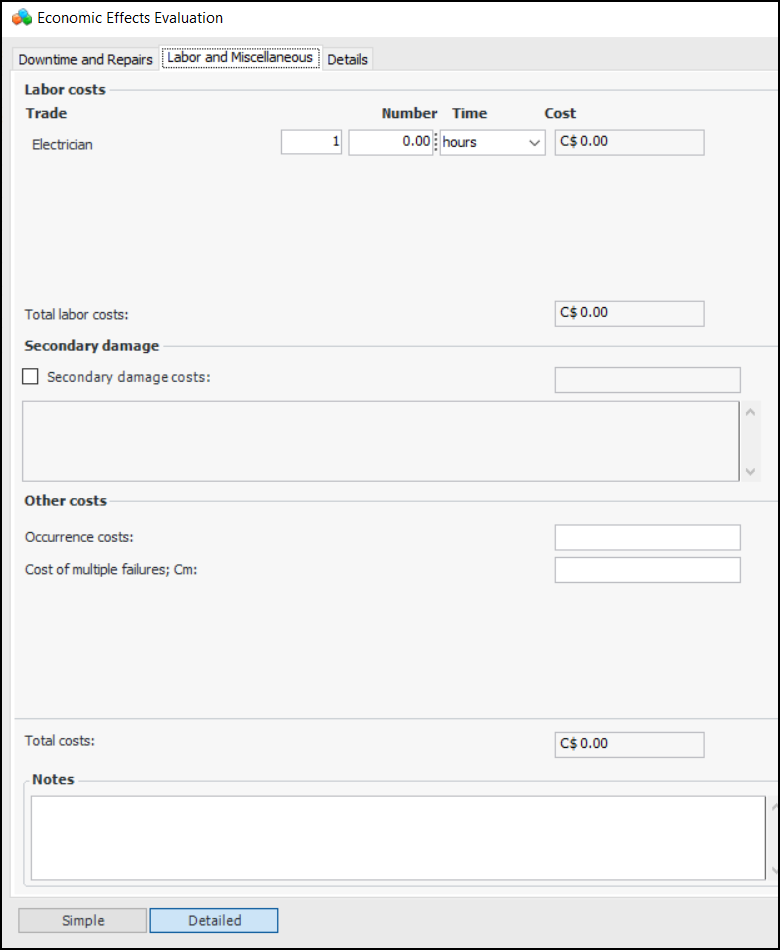
6. Select the Labor and Miscellaneous tab. For example:
7. Enter information to calculate labor costs. The number and types of trades listed in the Labor costs area are defined in the Economic Evaluations settings. They vary depending on the trades defined for the site and selected for the evaluation. For each trade, enter the amount of time required to respond to the failure. APM calculates the cost based on the trade’s rate.
8. Secondary damage is additional damage caused to other assets by the initial or primary failure. If appropriate, select Secondary damage costs and enter an amount and a description of the damage. This information is included in the total costs and shown on the failure mode’s Failure Data tab.
9. In the Occurrence costs box, enter the estimated fixed cost associated with a downtime occurrence. For example, this could be a fixed cost associated with restarting a machine after it has been shut down.
10. In the Cost of multiple failures box, enter the estimated cost if a protected function fails while its protective device or protective system is in a failed state.
11. In the Notes box, you can enter additional information about the evaluation. Notes are collected and available in several locations.
12. Select the Details tab. In the Analyzed by list, select the team member who performed the evaluation.Note: For information about creating production cost rules, see Setting up Production Loss Rules on an Asset.
13. When you have finished the evaluation, click OK. The result of the economic evaluation is shown in the risk matrix. For example:To Evaluate Health and Safety, Environmental, and Reputation Consequences
1. Click Health and Safety, Environmental, and Reputation in turn. The evaluation form appears. The evaluation types (simple, detailed), categories, and questions available to you depend on the form’s design and the asset properties.At any time, you can refer to the Asset Properties tab for detailed information about the asset.
2. Complete each of the evaluations, selecting options for each category, entering notes, and using the arrow buttons to move between categories. If different evaluation types have been defined in the form’s design, you can select Simple or Detailed, as required by the complexity of the failure mode that you are analyzing.As you move through the analysis, the Severity box displays the most severe score assigned to your selections. For example, if you select options for three categories, two of which have a result of “Negligible” and one with a result of “High”, the score for the evaluation as a whole will be “High”. However, if a mitigation category has been defined for the evaluation, its score can raise or lower the severity. The resulting ranking is used in the risk matrix.
3. In the Analyzed by list, select the team member performing the evaluation.
4. In the Note box, you can provide additional information about the analysis. Notes are collected and available in several locations.
5. When you have completed an evaluation, click OK. The evaluation form closes and the result is selected in the risk matrix. For example:To Assign a Detectability Value
1. In the Criticality view, select the appropriate value from the Detectability list below the risk matrix. This number is used in the relative risk calculation.To Evaluate Confidence Factors
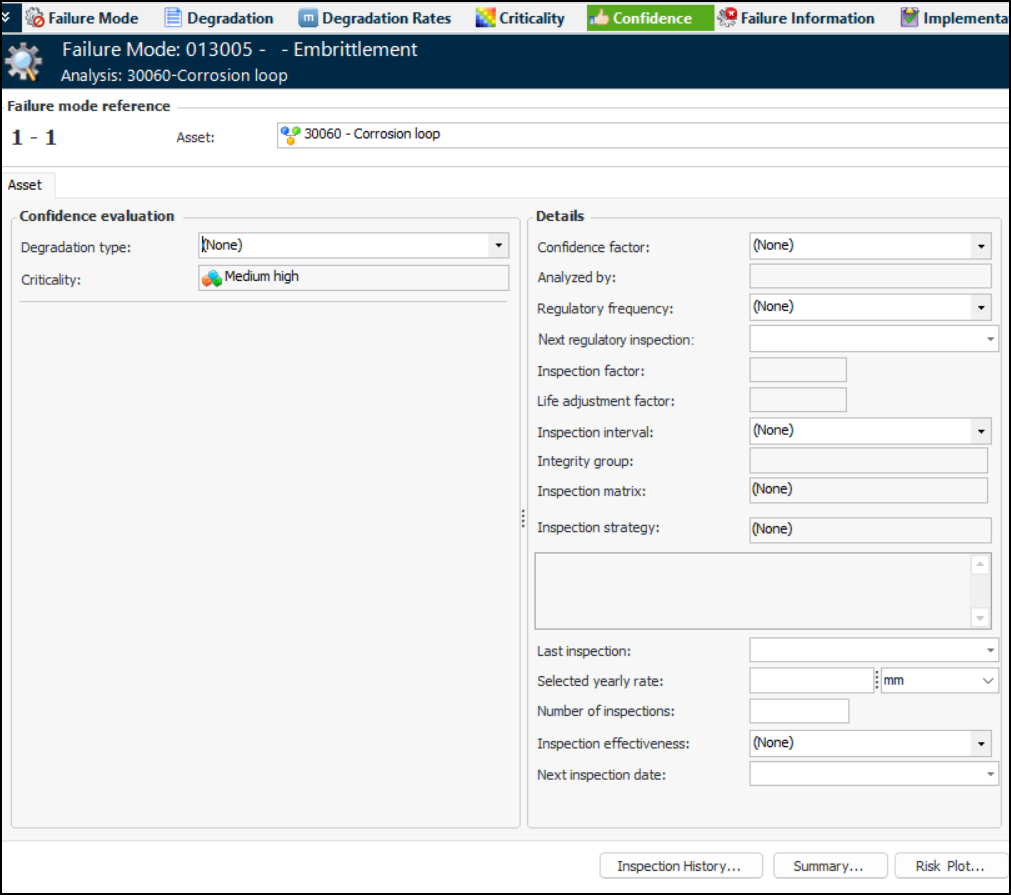
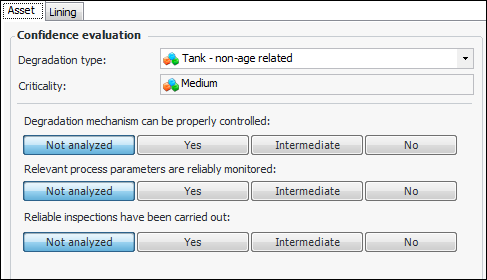
1. Select the Confidence view. For example:The Criticality box shows the result of the evaluations you performed on the Criticality view. If the degradation type has been identified in the failure mode’s degradation details, it is selected here.
2. In the Confidence evaluation area, select a degradation type. One of the following occurs:
• The Confidence factor box displays the default for the degradation type. If the degradation type’s settings allow, you can select another value from the Confidence factor list.For each confidence statement, click a response, for example, No, Yes, or Intermediate. The Confidence factor box displays the result of your selection, indicating if confidence is low or high. The inspection factor, inspection interval, integrity group, and inspection strategy might also be supplied.
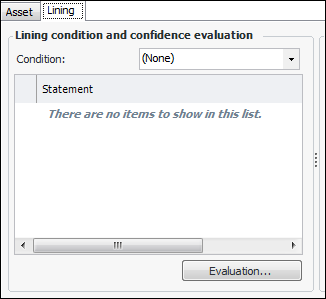
3. The Lining tab is available if the asset has lining properties and the degradation type requires a separate confidence evaluation. Select the Lining tab. You will see one or more of the following:
• The Condition list is available. Select a value from the list to describe the state of the lining at the time of inspection.
• Confidence statements are presented as they are on the Asset tab. Select the appropriate responses.Note: If both the Condition list and either confidence statements or an evaluation are available, the lesser of the two results determines the life adjustment factor shown in the Details area.
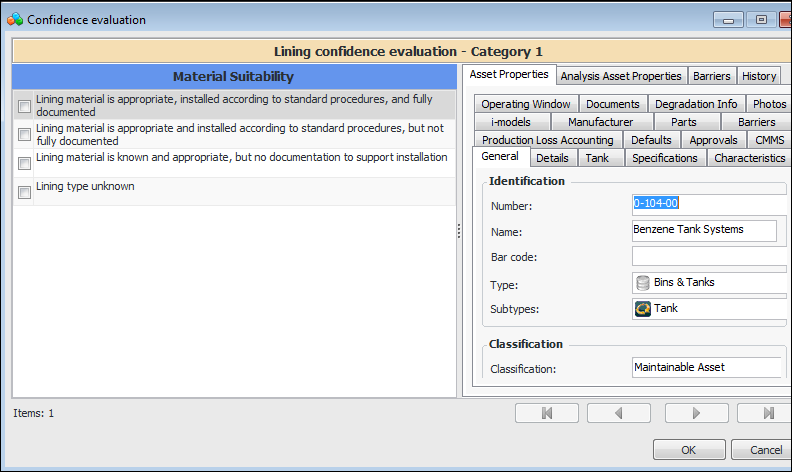
• The Evaluation button is available. For example:Select a statement and click OK. The form closes and the statement is shown in the Lining tab. The Details area displays the inspection factor, inspection interval, or both, depending on the evaluation form’s properties.
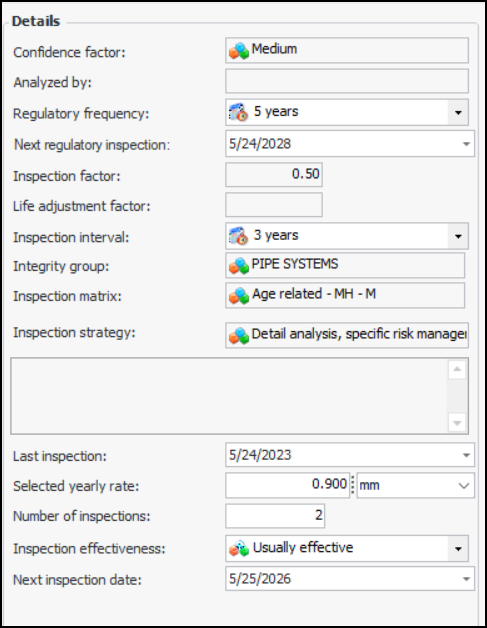
4. In the Details area, add the regulatory inspection frequency and the last inspection date. APM calculates the next regulatory inspection date, which you can change if required.Note: If you selected a degradation rate on the Degradation Rates tab, as explained in Adding Degradation Rates to RBI Failure Modes, the selected yearly rate and next inspection date are copied to the Details area. Otherwise, you can enter these values here.In this example, the confidence evaluations resulted in an inspection factor of 0.50, as shown in the Details area:
Viewing the Risk Analysis Summary
1.
3. Click Close to dismiss the window.When you have performed risk assessments for all of the failure modes in the analysis, you can compare them using the Risk Assessment view. For more information, see Viewing Risk Analyses for RBI Failure Modes.