Creating Scheduling Relationships for Tasks

This section explains how to create scheduling relationships between tasks on a work order. You can do this by entering the predecessor information for each task.
Note: When you create a work order with multiple tasks, the system automatically sets up finish to start dependencies between the tasks. If necessary, you can edit or delete these dependencies.
If the work order already has the “Planned” status, you will need to redraft the work order before you can add or edit dependencies.

Relationship Types

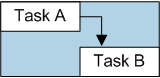
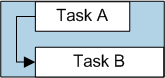
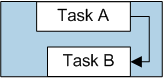
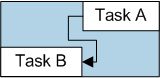
Four relationship types are available:

Lags and Overlaps

For each task relationship, you can enter a lag time. You can use lags to offset the start or completion date of two linked tasks. For example, if two tasks have a finish-to-start relationship with a four-hour lag, task B will start four hours after the completion time of task A.
You can also use lag time to overlap two tasks by entering a negative lag time. For example, to set task B to start four hours before task A is completed, link the tasks with a finish-to-start relationship, and enter a lag of “-4” hours.
Note: Task scheduling relationships (predecessors and successors) do not apply when simple scheduling is used.

To Enter Predecessors for a Task

1.
Open the work order task. On the Planning view, select the Planning tab and the Dependencies tab. This tab shows the existing dependencies for this task.
2.
3.
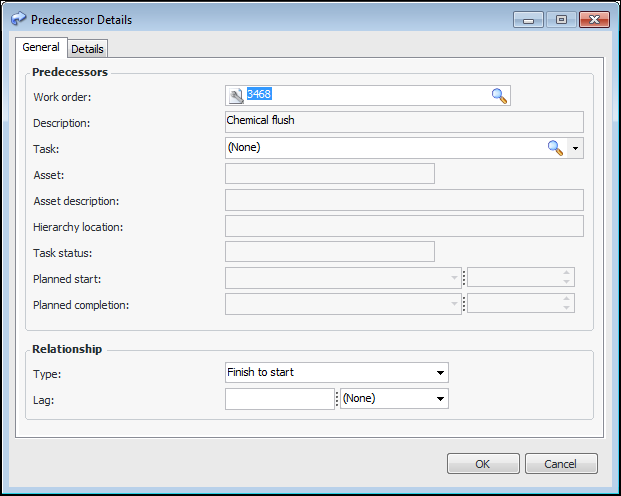
Click New, or double-click an existing dependency. The Predecessor Details dialog appears.
4.
Finish-to-start (FS): The successor task cannot start until the predecessor is finished
Start-to-start (SS): The successor task cannot start until the predecessor starts
Finish-to-finish (FF): The successor task finishes at the same time as the predecessor
Start-to-finish (SF): The successor task finishes at the same time as the predecessor starts
5.
Select the Details tab. On this tab, you can enter any notes about the relationship and review the descendants information.
6.
7.
8.