|
**Setting up Work Types
Work Types and Interoperability (AWEIS)
When AssetWise Enterprise Interoperability (AWEIS) has been implemented to exchange data between APM and an external CMMS, the CMMS is the work management system. This means that APM work orders, work requests, and standard jobs are not used. Instead, you can create requests for work to submit to the CMMS, which in turn sends interop work requests, interop work orders, and solution packages (pre-planned work) to APM. This makes the job of setting up work types simpler. It also allows you to configure work type settings that are tailored to the sites where the work types are used. For more information, see Setting up Site-Specific Work Types.Work Types and Solution Packages (AWEIS)
A standard task’s work type determines if solution packages can be identified on its Properties view, Solution Packages tab. Requests for work generated from the checksheets associated with the standard task are then used to trigger the correct solution packages in the CMMS.Note: Support for solution packages on standard tasks is “generally available” functionality. To use it, you must first enable feature 119 in APM. In the Enterprise window, select the Features view and the Enabled Features tab. Click Browse, select “Solution package identification on standard task” and click OK. If APM is running as a smart client, click Refresh Enabled Features on the server. Then restart the client to use the functionality.Work Types and KPIs
Task Purpose
Activity Reporting
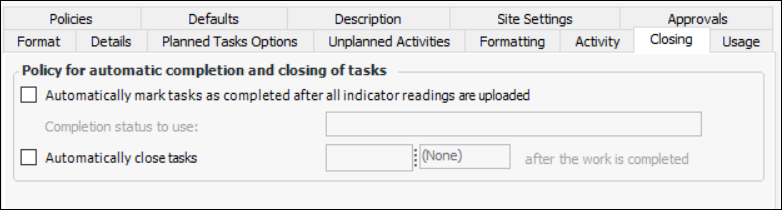
Automatic Completion and Closure of Work Order Tasks
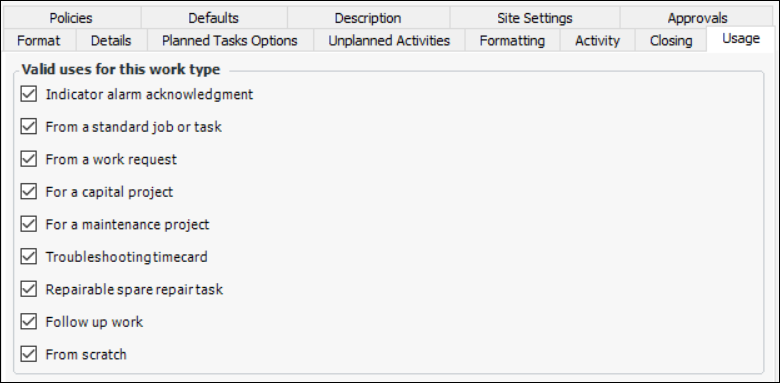
Note: You must then set up a scheduled action (Close Completed Tasks) to look for completed tasks for which the length of time has elapsed and then close the tasks. For more information, see Creating a Scheduled Action.Valid Uses
Override GL Account
Regular vs. Standing Work Orders
Work Classifications
Work Priorities (AWEIS)
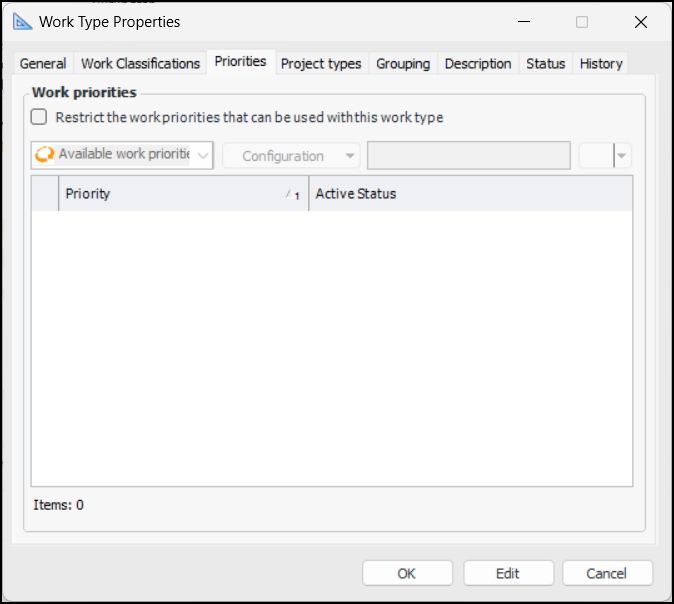
You can restrict the work priorities available for use with a work type. In the Work Type window, the Priorities tab is available when AWEIS is active and feature 131 is enabled. The work priorities that are available for selection are filtered on assets, standard tasks, checksheets, and requests for work.Note: The restricted work priorities feature is generally available in APM. You must first enable feature 131 to use the functionality. In the Enterprise window, select the Features view and the Enabled Features tab. Click Browse, select “Provide the ability to limit the priorities that can be used by a work type” and click OK. If APM is running as a smart client, click Refresh Enabled Features on the server. Then restart the client to use the functionality.Project Types
UI Formatting Options
You can use these options to simplify work orders and standard tasks that have certain work types. When you remove any of the options from the work type, the resulting work order task and standard task do not display that information. You can remove any of the following: planning information, standard documents, indicators and indicator snapshots, component activities, asset status information, scheduling dependencies, Activity view, Costs view, Schedules view, and Survey information.Work Type Defaults
You can pick a default work type for the site. APM uses this default work type when a user acknowledges an indicator alarm by creating a new work order from scratch. This setting is on the Indicator Settings dialog (Administration menu, Inspection Management Settings option, then Indicator Management option, Acknowledgment Policies tab).You can also pick default work types for each asset. You can do this on the Asset window, Properties view, Defaults tab. When a user creates a work order for an asset from scratch, APM uses this work type. Work order tasks created from standard tasks use the work type selected on the standard tasks.Approval Options
If you wish, you can require approval of work orders based on the work type selected. For example, you could require Corrective type work orders to be approved, but allow Inspections to proceed without approval. You can select the approval setting for work types in the site’s Approval Settings dialog (select the Administration menu and then Approval Settings option).To Set up a Work Type
1. From the Site window, select the Reliability Program view, Settings tab. Select the Reliability Program tab and the Reliability program settings node in the tree.Tip: You can also click the Administration menu and then Reliability Program Settings. The Reliability Program Settings dialog appears.
2. Select the Work Types tab. It lists the current work types:Tip: You can also create work types on the site’s Work Management view. Select the Settings tab, Work Orders or Work Management tab, and Work Types tab.
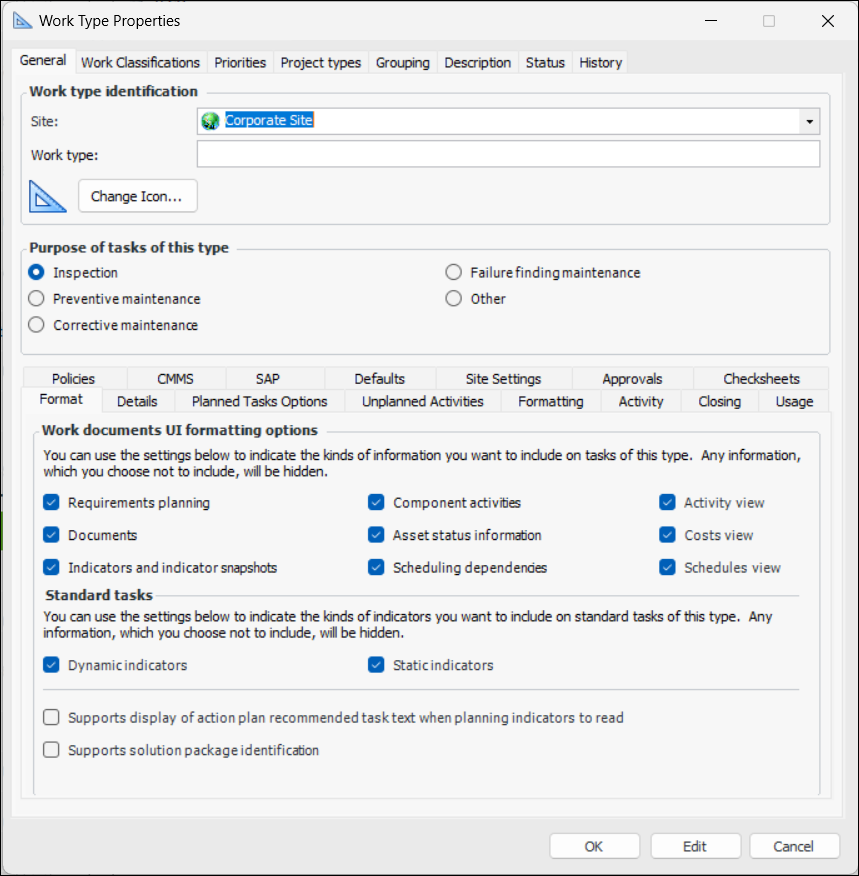
3. Click New. The Work Type dialog appears:
4. On the General tab, enter the following settings:
• Inspection – Inspection tasks are performed to detect an imminent failure (and therefore allow a planned maintenance task to be scheduled to prevent the failure) or to detect a hidden failure.
• Preventive maintenance – Preventive maintenance tasks can involve the replacement of aging equipment or minor tasks such as lubrication. Preventive maintenance can also be performed when an inspection predicts that a failure is about to occur.
• Corrective maintenance – Corrective tasks are performed when a random failure takes place or when an inspection reveals a hidden failure.
• Failure-finding maintenance – Failure-finding tasks are used to determine whether a specific hidden failure has occurred.
•
5. On the General tab, Format tab, select the kinds of information to include on work documents of this type. Any information not selected is hidden on work orders and standard tasks.
Select this option to include the Planning tab on work order tasks and standard tasks using this work type. This tab allows you to add start and end dates, labor requirements, materials, tools and services for the task, as well as other planning details.When this tab is hidden, users will not be able to add trade, materials, tool, or service requirements to the task. The Create Pick List and Create Purchase Order options will also not be available.
Select this option to include the Documents tab on work order tasks and standard tasks using this work type. This tab allows you to add procedures, instructions, and other types of documents to the work order task.
Select this option to include the Inspection tab on standard tasks and work order tasks using this work type. This tab allows you to plan a list of indicators to read for the task and, on work order tasks, to view any indicator snapshots taken during the task’s life cycle.
Select this option to include the Component Activity tab on work order tasks using this work type. On work order tasks, this tab allows you to plan component swaps and repairs.
Select this option to include the Asset Status Change tab on work order tasks and standard tasks using this work type. This tab allows you to set a new status for the asset being worked on when the work order is completed. You can also select whether a new asset life will be started, whether triggering counters will be reset, and whether the asset’s manufacturer information should be changed when the work is completed.
Select this option to include the Dependencies tab on work order tasks using this work type. On work order tasks, this tab allows you to plan scheduling dependencies and lags.
Select this option to include the Activity view on work orders and work order tasks using this work type. This view lists objects related to the work order or task, for example, activity reports, indicators, and failures.
Select this option to include the Costs view on work orders and work order tasks using this work type. This view displays planned and actual costs in list and graph formats, as well as a list of transactions.
Select this option to include the Schedules view on work order tasks using this work type. This view displays information about the schedule entries for the task.
6. In the Standards Tasks area, you can use the settings to hide or show options in the Standard Task window, Inspection tab:
When this option is selected, a side bar is displayed in the Standard Task window on the Inspection tab, Static tab. The bar displays recommended tasks and inspection strategies from action plans that identify the standard task as the inspection task.
When this option is selected, standard tasks that use this work type display the Solution Packages tab on the Properties view.
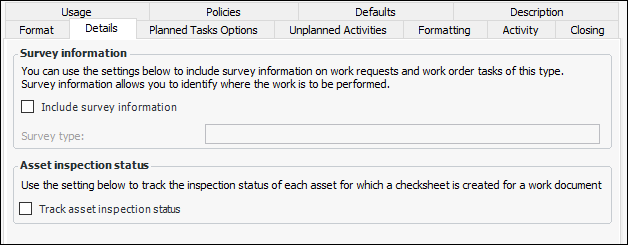
7. In the Survey information area, select Include survey information and then select a survey type from the list, to display survey information on the work request or work order task.In the Asset inspection status area, you can turn on the option that will track the inspection statuses for each asset for which a checksheet is created for a work document (APM work order task or interop work order). Possible inspection statuses are:
• No inspections required – appears if Track asset inspection status is not selected on the work document’s work type
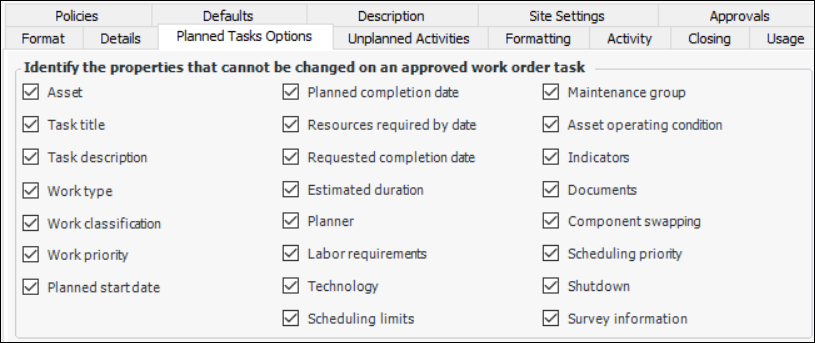
8. On the General tab, Planned Tasks Options tab, you can select which properties can be changed on approved work order tasks of this type. All options are selected by default:
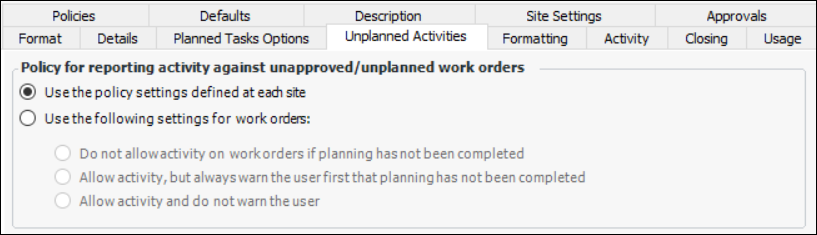
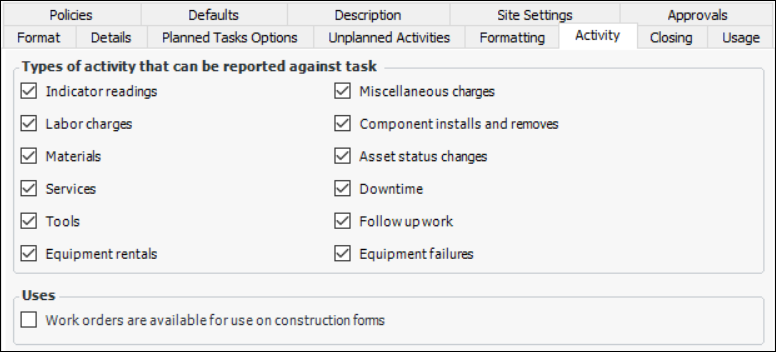
9. On the General tab, Unplanned Activities tab, you can override the site’s unplanned work order policy setting on an individual work type. You can also select the types of activities that can be reported on activity reports for tasks using this work type:
10. On the General tab, select the Formatting tab to select the font, text color, and back color to distinguish this work type in table rows.Note: To have the formatting appear in a table’s rows, open the table configuration, select the Appearance tab, then the Grid tab and Row Formatting tab. Select the join path to the work type’s FontAndColorControl attribute.
11.
When this option is selected, the Readings tab is available on the Activity Report dialog for work order tasks that use this type.When this option is cleared, the Readings tab is not available on the Activity Report dialog. Users may still be able to enter readings using checksheets.
Select this option to have the system display the Labor tab on Activity Reports for work order tasks that use this work type.
When this option is selected, the Materials tab is available on the Activity Report dialog for work order tasks that use this type.When this option is cleared, the Materials tab is not available on the Activity Report dialog. Users might still be able to enter material issues using another method.
When this option is selected, the Services tab is available on the Activity Report dialog for work order tasks that use this type.When this option is cleared, the Service tab is not available on the Activity Report dialog. Users might still be able to enter service acknowledgment transactions in other ways.
When this option is selected, the Tools tab is available on the Activity Report dialog for work order tasks that use this type.When this option is cleared, the Tools tab is not available on the Activity Report dialog. Users might still be able to enter tool transactions in other ways.
When this option is selected, the Rentals tab is available on the Activity Report dialog for work order tasks that use this type.When this option is cleared, the Rentals tab is not available on the Activity Report dialog. Users might still be able to enter equipment rental receipts and usage in other ways.
When this option is selected, the Miscellaneous tab is available on the Activity Report dialog for work order tasks that use this type.When this option is cleared, the Miscellaneous tab is not available on the Activity Report dialog. Users might still be able to enter miscellaneous cost transactions in other ways.
When this option is selected, the Component Activity tab is available on the Activity Report dialog for work order tasks that use this type.When this option is cleared, the Component Activity tab is not available on the Activity Report dialog. Users might still be able to enter component swaps in other ways.
When this option is selected, the Asset Status tab is available on the Activity Report dialog for work order tasks that use this type.When this option is cleared, the Asset Status tab is not available on the Activity Report dialog. Users might still be able to enter change the asset status in other ways.
When this option is selected, the Downtime tab is available on the Activity Report dialog for work order tasks that use this type.When this option is cleared, the Downtime tab is not available on the Activity Report dialog. Users might still be able to enter downtime in other ways.
When this option is selected, the Follow-up Work tab is available on the Activity Report dialog for work order tasks that use this type.When this option is cleared, the Follow-up Work tab is not available on the Activity Report dialog. Users might still be able to report follow-up work in other ways.
When this option is selected, the Failures Resolved tab is available on the Activity Report dialog for work order tasks that use this type.When this option is cleared, the Failures Resolved tab is not available on the Activity Report dialog. Users might still be able to report equipment failures in other ways.In the Uses area, you can allow work documents (work order tasks or interop work orders) with this work type to be used on construction forms. For example, in the Construction Form window, the Work order selection list contains only objects with work types that support construction forms.
12. On the General tab, select the Closing tab to set the policy for automatic completion and closing of tasks:
13.
14.
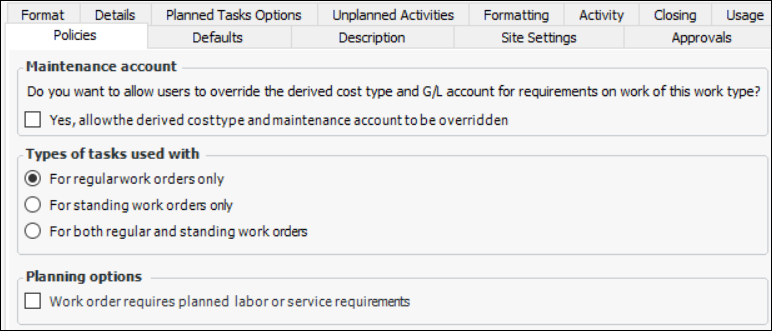
The work order formats (regular, standing, or both) that the work type can be used with. For example, if the option For regular work orders only is selected, users will not be able to select this work type when creating a standing work order.
15. On the General tab, select the Defaults tab. If you select Calculate estimated duration, this option is enabled by default on work order tasks that use this type.
16. If AWEIS is active for the site, the Site Settings tab is available on the General tab. For more information, see Setting up Site-Specific Work Types.
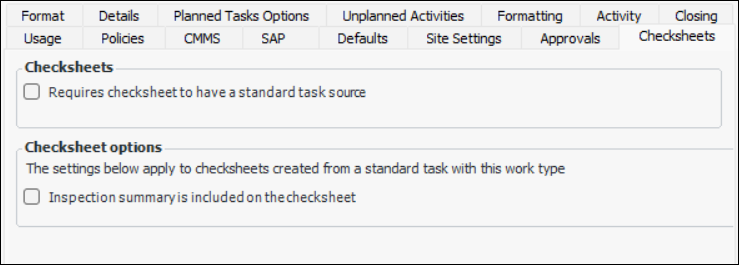
17. When Inspection summary is included on the checksheet is selected, checksheets created from standard tasks or jobs with this work type include the Inspection Summary view. The inspector can record a summary of findings, analysis, and recommendations. The report includes a summary of actions taken, such as alarm acknowledgments, follow-up tasks, follow-up work requests, and failure mode review requests.
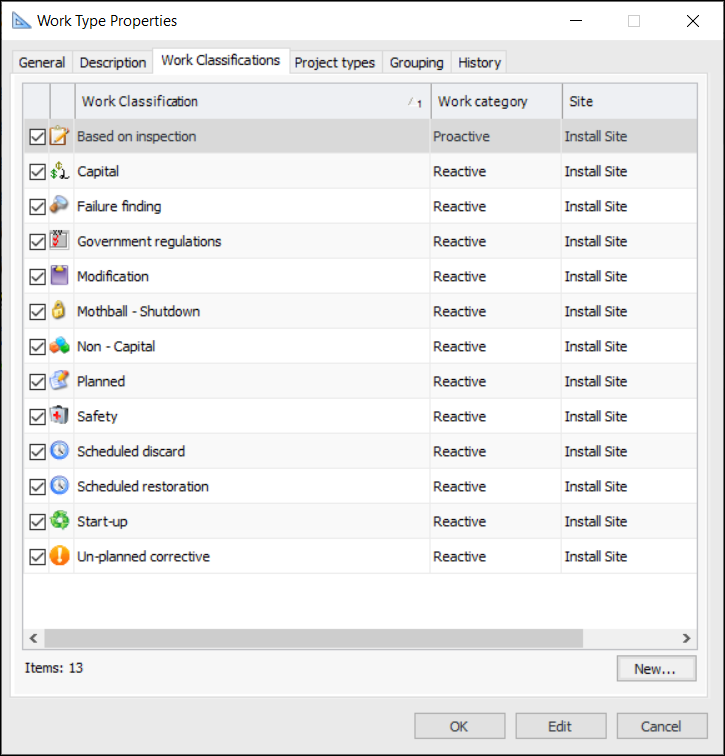
18. Select the Work Classifications tab:Tip: To create a classification, click New. For more information about creating classifications, see Setting up Work Classifications.
19. Select the Priorities tab.
20. To limit the work priorities available with this work type, click Restrict the work priorities that can be used with this work type. The “Available work priorities” configuration lists active work priorities for the site.
22. Select the Project Types tab. Click Browse to select the project types that can be used with this work type.
23. Select the Description tab to provide information about the work type.
24. When you are finished, click OK. The work type is added to the tab.