Performing MTA2 Risk Analysis with Weighted Severities

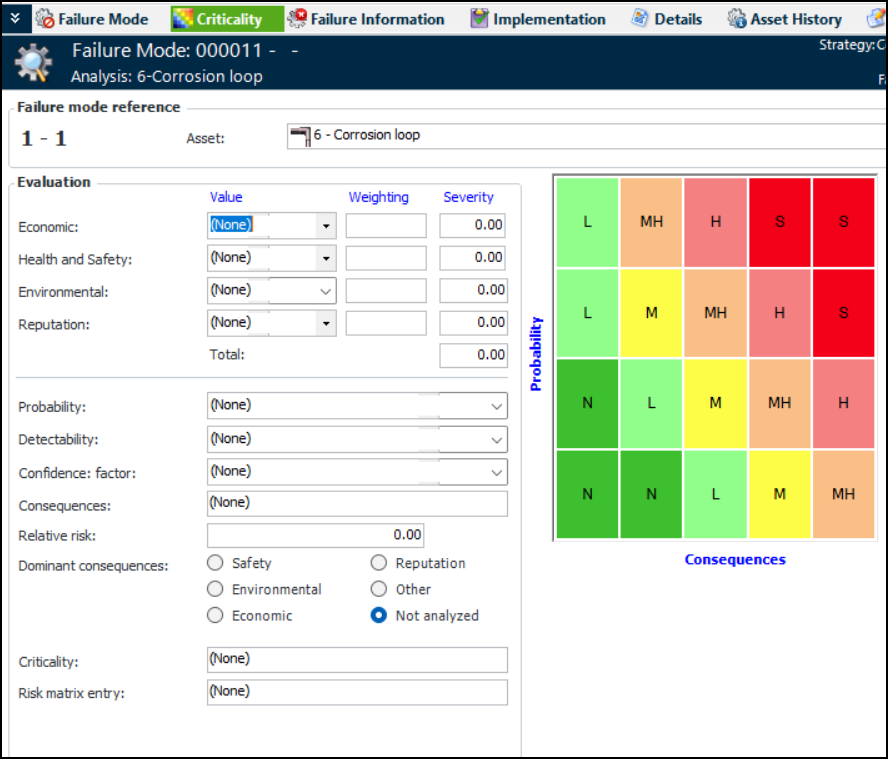
In the process of evaluating a failure mode, you can quantify the relative risk (criticality) associated with the failure by evaluating the consequences (severity of the effect) and the probability of the failure occurring, assigning values for each factor. If the analysis supports it, you can also assign a detectability value. APM then calculates the relative risk by multiplying the severity by the probability and then by the detectability.
When the relative risk is established, APM calculates the failure mode’s consequence priority using a set of customer-defined rules. The consequence priority rules can be based on the failure mode’s severity, relative risk, downtime costs, downtime duration, or a combination. For example, the Extreme consequence could be assigned to failure modes whose total severity is equal to 5.0.
After you have analyzed the failure modes, you can compare failure modes and identify the relative importance of addressing them. The Risk Assessment view in the Strategy Development Analysis window includes failure mode lists based on criticality, consequence priority, severity, and relative risk, as well as a risk plot, risk matrix, and lists of the evaluations. This view is also available for the asset.
APM provides two ways to perform failure mode risk analysis:
With both methods, APM calculates the relative risk and displays it in the risk matrix chart. The method available in the Maintenance Action Plan window depends on the option selected in risk analysis settings.
For instructions on using evaluation forms, see Performing MTA2 Failure Mode Risk Analysis.
Note: Before you can perform risk analyses, the severities, probabilities, failure mode consequence priorities, confidence factors, and risk matrix entries must be set up in the site’s strategy Development settings. For more information, see Risk Analysis Settings.

To Perform Risk Analysis using Weighted Severities

1.
Open the analysis, select the Facilitation view, and open the failure mode. The Maintenance Action Plan window appears.
2.
Select the Criticality view.
3.
4.
Economic: The economic consequence of failure reflects the financial effect of the failure on assets and production. Labor and material costs associated with lost production and with repairing or replacing the damaged equipment are economic consequences.
Health and safety: Equipment failure can cause hazards in the workplace. Examples are extreme temperatures, noxious fumes, and the release of liquids that can kill or injure someone.
Environmental: There is an unacceptable risk that the effects of this failure mode could breach a known environmental standard or regulation.
Reputation: The impact that negative media attention has on an organization’s ability to operate in good faith. Typically, the severity of bad press is evaluated in terms of how far-reaching it is and how long it takes to mitigate.
5.
APM calculates the total severity for each of the categories by multiplying the severity by its weighting factor. The failure mode’s total severity is calculated as the sum of the categories’ severities.
6.
Enter the amount of time and the unit of measure. The corresponding probability value is displayed in the Failure probability box.
7.
8.
APM calculates the relative risk for the failure mode by multiplying the total failure mode severity by the probability of failure and then by the detectability, if used.
When you have entered all of the information that is required by consequence priority rules, APM calculates the criticality number. The risk matrix entry is shown in the risk matrix chart.
9.
When you have performed risk analyses for all of the failure modes in the analysis, you can compare them using the Risk Analysis view. For more information, see Viewing Risk Analyses for MTA2 Failure Modes.