Creating MTA2 Failure Modes

A failure mode is a single event that causes a functional failure. For example, if a pump’s impeller becomes worn, the pump cannot convey liquid at the required rate. The failure mode consequences are analyzed in maintenance task analyses to arrive at the recommended actions that prevent or mitigate failures.
There are several ways to add failure modes to an analysis:
Create each failure mode individually using the Maintenance Action Plan window. On the Info Worksheet tab, click the New list and then From Scratch to open this window.
This section explains how to create an individual failure mode using the Maintenance Action Plan window.

To Create a Failure Mode

1.
Open the analysis, select the Facilitation view, and then the Info Worksheet tab.
2.
3.
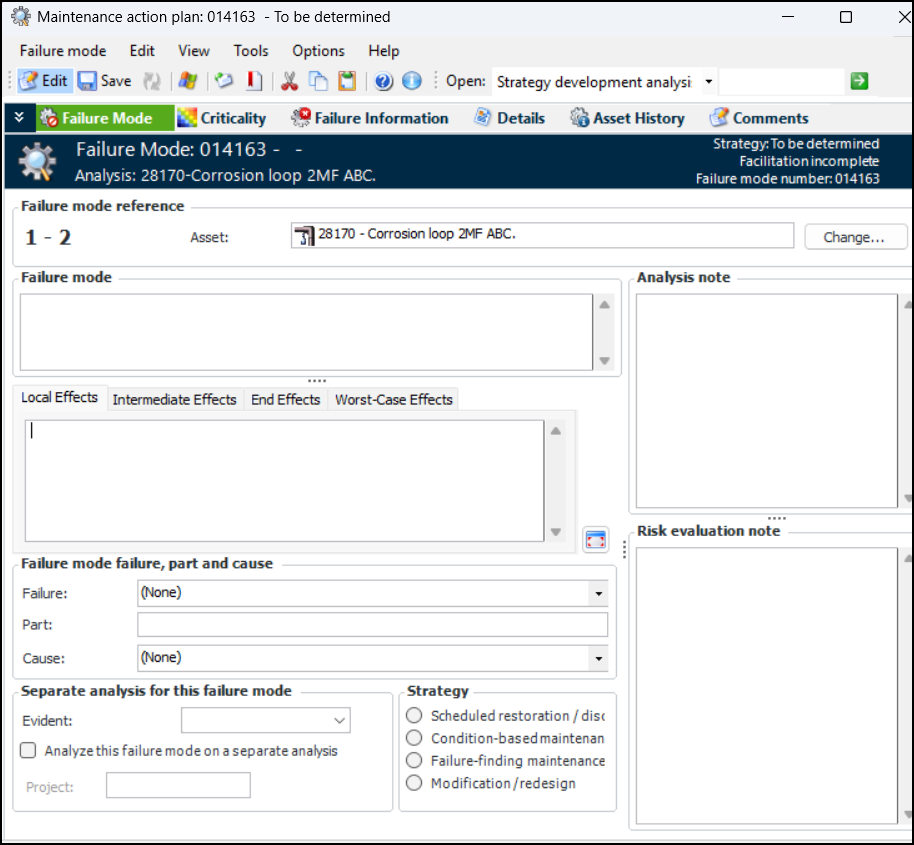
Click the New list and then From Scratch. The Maintenance Action Plan window appears. For example:
The Failure mode reference area displays the unique identifier for the failure mode, which consists of the asset’s sequence number and the failure mode number.
Tip: You can hide the notes boxes by selecting an option in the analysis’ failure mode options. In the Strategy Development Analysis window, select the Properties view and the Failure Mode Options tab. On the User Interface tab, click Hide notes sidebar.
4.
Click Change. The Change Asset dialog appears.
Click OK. The dialog closes and the asset number and name are shown in the Asset box.
Tip: You can also change one or more failure mode’s assets on the Strategy Development Analysis window by selecting the Implementation view and the Action Plans tab. Select the failure modes, right-click, and click Change Asset.
5.
In the Failure mode box, enter a description in the failure mode.
6.
If the Failure effects box is displayed, describe what happens when the failure mode occurs.
If the analysis supports extended failure effects, select the appropriate tabs and enter information:
Local Effects –Local effect on the piece of equipment
Intermediate Effects – Intermediate effect on a higher level equipment or asset
End Effects – End effect on the asset or system being analyzed
Tip: Click to open the Extended Effects dialog.
7.
In the Failure mode failure, part and cause area, select a failure and cause from the lists and enter a description of the effected part.
8.
In the Evident list, select “Yes” or “No”. A failure mode is evident if its effects become apparent to the operating crew under normal circumstances if the failure mode occurs on its own.
9.
If you wish to analyze a complex failure mode in its own MTA2, select Analyze this failure mode on a separate analysis. The Link button becomes available. You can link the failure mode to an analysis request that is tracked by a project. See Creating Analysis Requests for MTA2 Failure Modes.
You can then close the Maintenance Action Plan window. The current analysis maintains a reference to the failure mode, but you cannot assign it a recommended strategy.
10.
Scheduled restoration/discard: Scheduled restoration entails restoring the initial capability of an existing asset at or before a specified age limit, regardless of its apparent condition at the time. Scheduled discard or replacement tasks entail discarding an asset at or before a specified age limit, regardless of its condition at the time.
Condition-based maintenance entails checking for potential failures so that action can be taken to prevent the functional failure or to avoid the consequences of the functional failure. On-condition tasks are so called because the items that are inspected are left in service on the condition that they continue to meet specified performance standards.
Failure-finding maintenance involves checking a hidden function at regular intervals to find out whether it has failed. The intervals are calculated based on the required availability of the asset and the reliability of the protected function.
Modification/redesign is any one-time change to the equipment, training, maintenance or operating procedures, etc.
No scheduled maintenance means assets are left in service until a functional failure occurs, at which point they are repaired or replaced.
Review existing maintenance is available for secondary action plans only. This strategy alerts the analysis team to review an asset’s existing maintenance program to identify items that are no longer required.
Not specified is the default task, and it means that an action type has not been determined.
Tip: Select the Asset History view to see information about the analysis asset’s checksheets, failures, work orders, and work requests. If APM has been configured to access live information in an SAP Plant Maintenance system, you can view the notifications and maintenance orders associated with the analysis asset’s equipment or functional location.
11.
Select the Criticality view to perform risk analysis. For more information, see Performing MTA2 Failure Mode Risk Analysis.
12.
Select the Failure Information view and the Failure Data tab to provide failure-tracking information. For more information, see Recording MTA2 Failure Data.
13.
Select the Failure Information view and the Failure Pattern tab to record the failure pattern. For more information, see Recording MTA2 Failure Data.
14.
Select the Feasibility view to evaluate whether the proposed maintenance strategies are worth doing; that is, whether implementing the maintenance tasks will cost less than the savings achieved by avoiding the failure. For more information, see Creating MTA2 Failure Modes.
15.
Select the Implementation view to develop action plans. For more information, see Developing Primary MTA2 Action Plans and Creating Secondary MTA2 Action Plans.
16.
Select the Details view and the Documents tab to browse for standard documents that are relevant to the analysis.
17.
Select the Details view and tab to apply an action plan status, select a failure type and failure classification, assign usage details, and see review requests and related root causes. For more information, see Recording and Reviewing MTA2 Failure Mode Details.
18.
Select the Details view, Symptoms tab to assign keywords or phrases that summarize the evidence an operator would see when the failure occurs or is about to occur. For more information, see Adding Symptoms to an MTA2 Failure Mode.
19.
20.