Failure Statistics

APM calculates its failure statistics when a failure is resolved. When a failure’s dates are changed or it is canceled, APM can recalculate the statistics for all assets affected by the change. APM also provides templates for key performance indicators, which you can use to track failure statistics over time. This topic explains how APM calculates the failure statistics.

Contents

Types of Statistics
Failure Restoration Times
Delays
Key Performance Indicators
Calendar- and Indicator-Based Statistics
Determining the Previous Failure to Use in Calculations
Rolling Failure Statistics up the Asset Hierarchy
Recalculating Statistics for Modified Failure Records

Types of Statistics

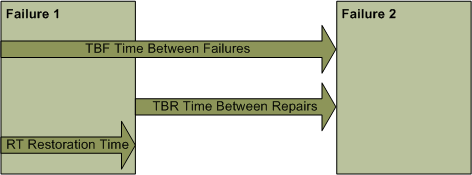
Based on the current and prior failures for an asset and failure mode, APM calculates three types of statistics: time between failures (TBF), time between repairs (TBR), and restoration times (RT).
Time Between Failures (TBF): The time between the start of the previous failure and the start of the current failure.
For the initial failure, the start date is determined to be the first available of the following options:
The TBF is then calculated as the duration between the start date and the failure’s resolved-at date.
APM calculates the mean time between failure (MTBF) as the average time between occurrences of a failure, assuming that the asset has a constant rate of failure.
Time Between Repairs (TBR): The time between the resolution of the previous record and the date on which the current failure occurred. TBR can also be calculated as TBF minus RT.
Restoration Time (RT): The time between the date and time when the current failure occurred and the date and time when it was returned to service.
For example:
The values are calculated for the asset that failed and each of its ancestor assets. This provides statistical information on the reliability of the lowest level component, the equipment, the system, and the plant itself.

Failure Restoration Times

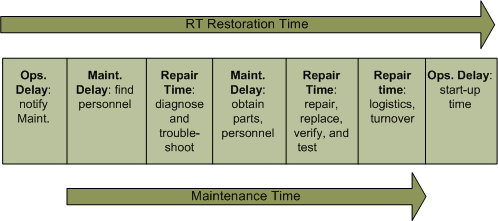
Restoration time is broken down into three statistics:
Restoration Time (RT): The total time to restore the asset to its normal operating condition. This is the total elapsed time from when the failure occurred until the asset is returned to service.
Maintenance Time (MT): The portion of the restoration time for which maintenance is responsible. This is the time from when the failure is reported until the failure is resolved, minus any operational delays.
Time to Repair (TTR): The actual time associated with the asset repair. Repair time is equal to restoration time minus all delays.

Delays

A delay on a failure record represents a period in the restoration time that was not spent on the repair of the asset. Delays can occur for a number of reasons. For example, delays might be needed to notify maintenance that a problem has occurred, schedule the maintenance job, get the appropriate personnel to the job site, deliver parts, or return the asset to service after the repairs are complete.
There are two main purposes for recording delays on a failure. First, recording the delays helps identify opportunities for improving the efficiency of the maintenance department. For example, if a large number of delays are occurring while the tradespeople are waiting for parts, you can look at ways to improve the work order planning or material delivery processes. On the other hand, if there are a lot of delays while tradespeople are waiting for other trades, the job assignment and crew co-ordination process can be improved. The other purpose for recording delays is to provide maintenance management with documented evidence of why repairs took the time they did. The problem might not be with maintenance but rather with the time it takes operations to report the problem.
Either maintenance or operations is identified as being responsible for each delay reported against a failure. The duration of the delay is also recorded. This information is used to calculate the total delay time associated with the failure resolution, the total maintenance delay time, and the total operation delay time. These values are then used in the calculation of the Maintenance Time and Repair Time for the failures.
The following example shows the breakdown of restoration time into maintenance time, operations delays, maintenance delays, and repair time.

Key Performance Indicators

APM provides templates for the following key performance indicators:
Failures: Mean time between failure in the last 12 months – The average time between occurrences of a failure within the last 12 months
Failures: Mean time between failure last month– The average time between occurrences of a failure within the last month
Failures: Mean time between repairs in the last 12 months – The average time between the resolution of one failure and the next occurrence of the failure within the last 12 months
Failures: Mean time between repair in the last month – The average time between the resolution of one failure and the next occurrence of the failure within the last month

Calendar- and Indicator-Based Statistics

Time between failures, time between repairs, and time to repair can be calculated in terms of both calendar time and the unit of measure of the asset’s primary cumulative indicator. The calendar time is a simple calculation of the days and time between two failures.
The indicator-based value sums the readings accumulated between two failures. The asset’s primary cumulative indicator is always used in the calculation of the failure statistics. The statistics are expressed in the indicator’s unit of measure.
APM uses the reading closest to the failure’s occurred-on and resolved-on dates in its calculations. For example, if a reading was entered five days prior to the failure and the next reading is entered eight hours after the failure is resolved, the reading entered after the failure is used. Conversely, if a reading is entered 20 minutes before a failure and the next reading is entered 45 minutes after the failure, the reading entered before the failure is used.
If a primary cumulative indicator has not been defined for an asset, only the calendar-based failure statistics are calculated.
Note: If you replace or remove an asset’s primary cumulative indicator after failure records have been created, the failure records are not affected by the change. They continue to use the original indicator for calculating failure statistics, P-F intervals, or both.

Determining the Previous Failure to Use in Calculations

When a failure record is created, APM adds a reference to the failure for the same asset and failure mode (or problem if failure modes are not defined for the asset) that occurred immediately prior to the current failure. This failure is the basis on which the failure statistics are calculated.
You can view the chronology of assets and failures in the failure record’s Statistics view, Assets tab.

Rolling Failure Statistics up the Asset Hierarchy

When a failure record is entered in APM, the failure is rolled up the asset hierarchy to the assets related to the failed asset. Failure statistics (TBF, TBR, TTR) are calculated for each of the assets. The failure is rolled up the hierarchy as follows:

Recalculating Statistics for Modified Failure Records

Changing a failure’s dates or canceling a failure results in failure statistics being recalculated (usually by a scheduled action).

When Occurred-On and Resolved-On Dates Change

If you change the date and time at which a failure occurred or the date and time at which it was resolved, APM recalculates the statistics for the affected assets. Similarly, if you add a failure that occurred before a previously recorded failure, APM recalculates the statistics and adjusts the asset’s chronology accordingly.
Changing the occurred-on date and time results in the TBF being recalculated for the updated failure and the previous failure. The TTR is recalculated for the updated failure.
If you change a failure’s resolved-on date, APM recalculates the TBR for the failure that occurred after the updated failure. The TTR is recalculated for the updated failure.

When a Failure is Canceled

Canceling a failure removes the failure from the asset’s failure statistics. The failure statistics for the failure immediately after the canceled failure are recalculated.