Creating a New Contract

A contract identifies that a formal pricing agreement exists between your organization and a supplier. Each contract includes purchasing information for one or more resources. The contract identifies the prices, terms and conditions for the purchases of those resources during the effective period of the contract.
You can create a contract document in APM to record the pricing agreement, and the list of resources that you have contracted to be supplied. This topic explains how to create a new contract from scratch. If you have completed the RFQ process, and want to create a contract from the RFQ document, please see Editing a Contract That Was Created From an RFQ.
Note: The My Desk view only displays the tabs described below if you are set up as a buyer on your employee record and the Purchasing Desk option is selected on the My Desk Settings tab.

To Create a New Contract

1.
2.
Select the Contracts tab. By default, this tab lists all of the open contracts for the site.
Tip: You can also create contracts from the My Desk view, Contracts tab.
3.
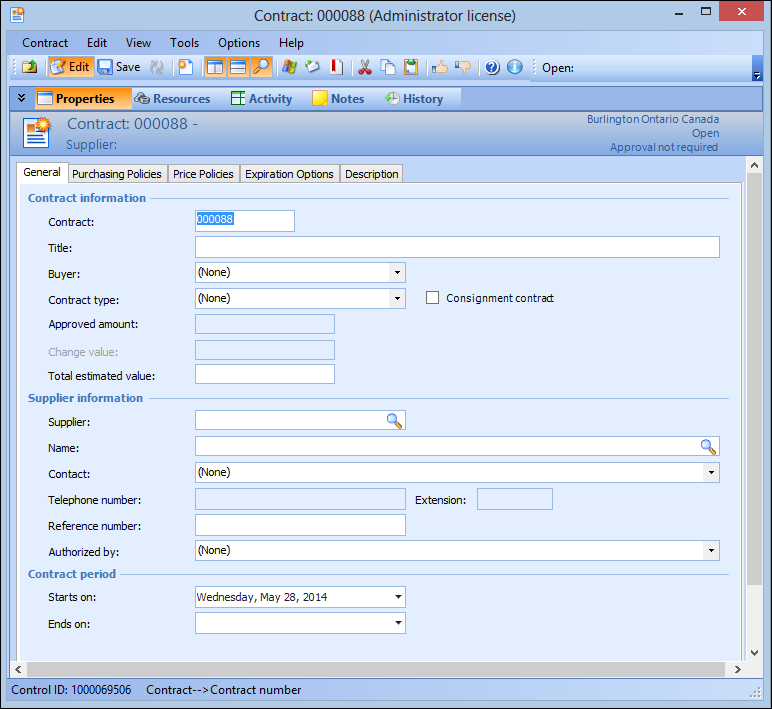
Click New. The Contract window appears.
4.
On the Properties view, General tab, enter the following information:
If you are redrafting the contract, enter the amount that the contract will increase over the current total contract amount. The system adds the Change value and the previously Approved value and displays the result in the Total estimated value box. When you send the contract to be approved again, only the changed amount will need to be approved.
5.
Select the Purchasing Policies tab. Set the following rules for the contract:
Estimate only: The prices will be entered as the default price on purchase demands or purchase order lines that reference a contracted supplier resource. The buyer will be able to change the default price.
Fixed: Prices that are fixed cannot normally be changed on purchase demands or purchase order lines that reference one of the contract’s resource prices. The price can only be changed in exceptional cases.
Guidelines only: The terms and conditions set on the contract will be entered as the default values on purchase demands or purchase order lines that reference a contracted supplier resource. The buyer will be able to change the default values.
Fixed: Terms and conditions that are fixed cannot normally be changed on purchase demands or purchase order lines that reference a contracted supplier resource. The values can only be changed in exceptional cases.
6.
7.
Invoice lines are matched to individual timecards: select this option to reconcile invoice lines within APM. A purchase liability will be created for each of the on-site contractor timecards.
Invoice lines are not matched to individual timecards: select this option to reconcile the invoice lines manually. You might want to do this if matching invoice lines to individual timecards is too rigid of a process.
8.
Select the Price Policies tab. Set the following rules for the contract:
Fixed: If the values are fixed, they cannot be changed on the supplier resource. Any changes to the contract’s values are automatically applied to the supplier resources.
Defaults only: If the contract’s information will vary on the supplier resources, choose the ‘information is default values only’ setting. The contract's information will be defaulted onto new supplier resources where it can be changed. Changes to the contract’s information are not applied to the supplier resources.
9.
10.
Select the Description tab. On this tab you can enter a detailed description of this contract.
11.
12.