Consignment Inventory

This topic explains the concepts behind setting up and tracking consignment inventory in the APM system.
To learn more about the regular inventory system in APM, see Inventory.

What is Consignment Inventory?

Consignment inventory is defined as material that is paid for on use, not on receipt. With consignment, you hold the material in your warehouse, but the supplier continues to own the material until it is used or issued. When the item is issued, your organization takes ownership of the material and assumes responsibility for payment.
Consignment inventory is tracked like regular inventory: in warehouses and inventory groups. Each consignment supplier has its own inventory group.
TOP

Supplier Consignment Agreements

Before you can define consignment prices or start stocking consignment inventory, you must identify the supplier as having an active consignment agreement. This ensures that a consignment type purchase or price is not inadvertently entered for a supplier with whom you do not have a consignment agreement.
TOP

Consignment Inventory Groups

An inventory group allows you to define specific information about a group of items in inventory. You can indicate that items are either owned by your organization or consignment inventory. For consignment inventory groups, you must identify the consigning supplier.
You must have at least one inventory group in the system, typically, the group for your regular, owned inventory. This inventory group is used to track inventory purchased under normal purchasing agreements; that is, inventory purchased at the time of receipt.
To track consignment inventory, you must also create an inventory group for each supplier with whom you have a consignment agreement.
Inventory groups are not used on their own but must be linked to warehouses to create warehouse inventory groups.
TOP

Consignment Warehouses and Inventory Groups

Depending upon how you have organized your warehouses, different types of inventory can be kept in each warehouse:
TOP

Life Cycle of a Consignment Item

Consignment inventory items have a similar life cycle to regular inventory items, with the following exceptions:
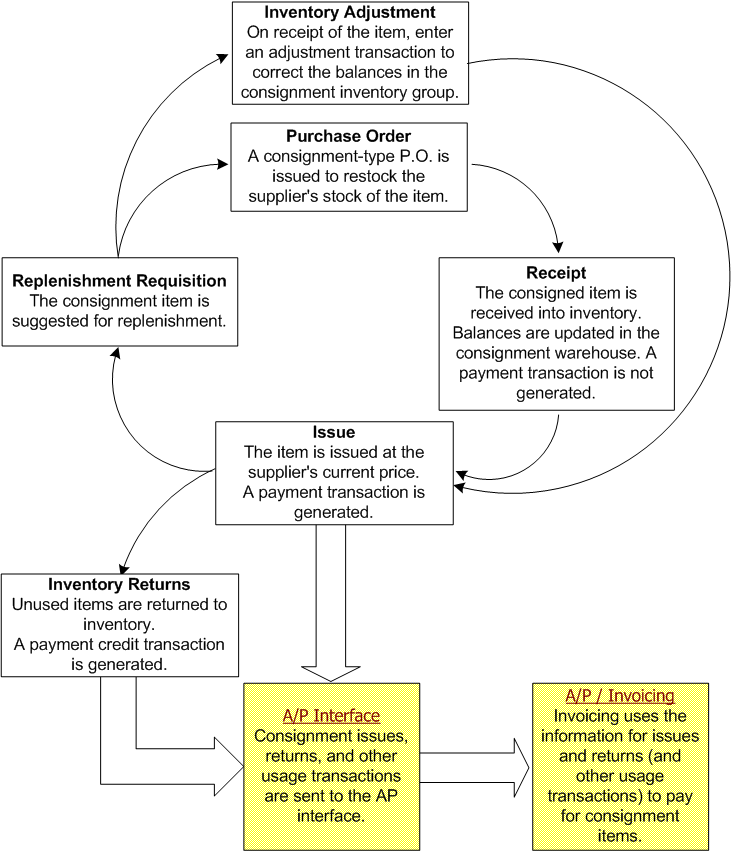
The following diagram shows the typical life cycle of a consignment inventory item.
TOP

Identifying a Resource as a Consignment Item

When the supplier’s consignment agreement is activated, you can start selecting the resources they will be supplying and entering the consignment prices. To identify a resource as a consignment supplier resource, you must select the consignment purchase type.
To track a consignment resource in inventory, you must first create a warehouse item (assign the resource to a warehouse). To identify the item as a consignment item, select a consignment warehouse inventory group for replenishment of the resource.
Although unlikely, it is possible for the same resource to be consigned with two different suppliers. In this case, create two warehouse items: one for each supplier’s inventory group. This situation usually only occurs if you are switching consignment suppliers and in some multi-site environments.
TOP

Replenishing Consignment Inventory

There are two ways in which consignment inventory can be replenished. The first method uses purchase orders and purchase receipts. With the second method, inventory adjustment transactions are used. The method that you choose will depend on who is responsible for maintaining the stock levels.
If your organization manages the consigned inventory, you will most likely choose the purchase order/receipt approach. This approach provides you with the most control and visibility of the status of the inventory. If the suppliers are managing their own inventory, you can choose to use the inventory adjustment approach.

Replenishing Using Purchase Orders and Receipts

The steps involved with the purchase order and receipt method are identical to replenishing regularly purchased items. However, there are some subtle differences in the information associated with the purchase order and receipt. The consignment purchase order line has the following unique characteristics:
The consignment receipt transaction has the following unique characteristics:
The disadvantage of this method is the use of “phantom” purchase orders to initiate the reordering. If you are interfacing the APM materials system to a non-APM purchasing system, you must ensure that your purchasing system is capable of dealing with these phantom purchase orders. If not, you will have to use the inventory adjustments approach.

Replenishing Using Inventory Adjustments

This method still uses a replenishment requisition to generate the list of resources that need to be replenished. However, rather than issuing a purchase order and entering receipts, you must enter adjustments to update the balances with the supplier’s new quantities. The consignment adjustment transaction has the following unique characteristics:
This process is significantly different than the process used to purchase regular items. Because of this, you might prefer to use the purchase order/receipt method, provided your purchasing system allows it.

Consignment Inventory Adjustment Reasons

You must designate the adjustment of a consigned item as being either the customer’s or supplier’s responsibility. Adjustments that are the customer’s responsibility are treated the same as an issue or return to consignment; the customer is responsible for the value of the adjusted quantity, and the transaction is marked for invoicing. Adjustments that are the supplier’s responsibility are not marked for invoicing, have no accounting information, and are calculated at the current consignment price. The selected reason for the adjustment identifies who is responsible for the adjustment.
If your organization is using APM to track consignment inventory, you might need to define at least one adjustment reason with the option Supplier is responsible for adjustments. You will need to use this reason if you are using the adjustment method to replenish consignment inventory.
Note that adjustment reasons can support site-specific settings, so the consignment responsibility can differ depending on the transaction site.
TOP

Consignment Inventory Accounting Issues

The Consignment Usage Not Invoiced account (CNI), is used as the offset account on consignment issues. This account is similar to the purchasing account Received Not Invoiced (RNI). If necessary, you can use the same account for both purchasing receipts and consignment issues. Simply identify the same account for both uses. You must select a whole GL account number.
The table below identifies the accounts and value associated with the resource transactions when consignment inventory is active.
1 No GL transactions are generated for the receipt of a consignment item. The inventory is still the property of the supplier. The inventory value is increased.
TOP

Canceling a Consignment Agreement

You can cancel a supplier’s existing consignment agreement. Canceling a supplier’s consignment agreement has the following effects:
After you cancel a supplier’s consignment agreement, you can reactivate consignment support. However, reactivating consignment support does not completely undo the updates that occurred when the agreement was canceled. Some items require manual action to undo the updates:
TOP