Creating a Component Location

A component location is a placeholder for a component in the asset hierarchy. It represents the physical location or position for a component (for example, a frame or housing unit for a motor or the location of a pump on a pumping system).
In APM, you must identify the location as an asset in order to install and remove components. APM tracks the installation history of all components that have been installed in a location and vice versa. You can trigger work for a location (if you want the work to be done no matter what component is installed at the time the work is triggered), and you can also track work orders and indicator reading trends for the location.
Component structures (components installed in locations) in APM can be simple or complex. A simple structure has one location into which one component is installed. It could have one or more spares on hand in case the first one fails to function at the expected level. An assembly in APM requires a component to be set up with sub-components. The locations into which the sub-components are installed must match in number and type.

To Create a Component Location

1.
From the Site window, select the Assets view and then the Physical Hierarchy tab.
2.
Tip: When you create assets from the hierarchy, APM automatically fills in the parent information. You can also add assets from the Listing tab by clicking New. With this method, you must add the parent asset information.
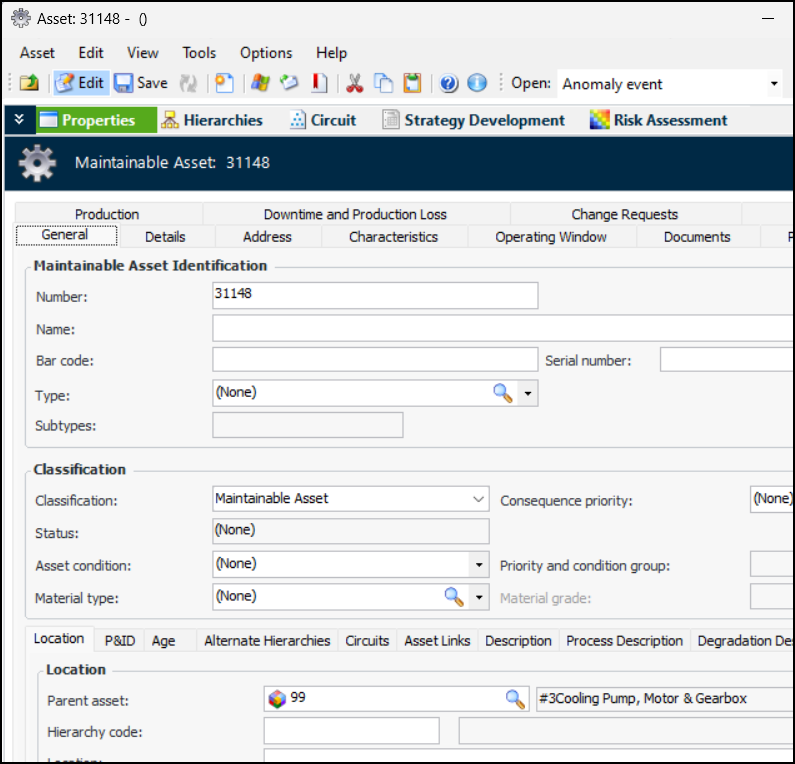
The Asset window opens, showing the Properties view, General tab. For example:
Note: The CMMS tab appears in the Asset window when the Work Management Integration module is licensed and activated. For information, see the guide for the APM CMMS Integration plug-in you are using.
3.
On the General tab, identify the asset:
Note: When the type is selected for an asset, the number of tabs displayed changes based on the type’s settings and classification. For component locations, the Component tab is added the Genera tab, which allows you to install a component.
A tab for each subtype is added to the asset’s Properties view, where you can enter additional information about the asset.
Note: When a component asset is installed in a component location, the component’s Asset window, Properties view contains a Location - asset# tab that displays the specification tabs for the location’s subtypes. Similarly, the component location’s Asset window, Properties view displays a Component - asset# tab so that you can view the specifications for the component’s subtypes.
4.
In the Classification area, provide the following information:
5.
On the General tab, Location tab, select the appropriate options:
Tip: You can click the browse icon and point to the location on a map to have APM assign the coordinates. For more information, see Setting Map Coordinates.
6.
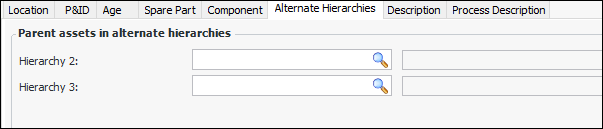
If you are using additional hierarchies, you can select the Alternate Hierarchies tab to establish the new asset’s position in it. This tab lists all of the hierarchies defined for the enterprise. For example:
Click a browse icon to select the parent asset in the alternate hierarchy.
7.
Select the Description tab to add general information about the asset.
8.
Select the Process Description tab to describe the process taking place in the asset. For example, enter a degradation-focused summary of the movement of fluid through a corrosion loop.
9.
On the Details tab, enter the appropriate information, for example:
10.
11.
Select the Documents tab to view and select standard documents. For more information, see Adding Documents to an Asset.
12.
Select the Photos tab and then click Browse to select inspection photos to be included with this asset.
13.
Click Open Folder to view the location.
Tip: You can also drag and drop photo files into the table.
14.
Select the Parts tab to add a parts list. For more information, see Creating a Parts List for an Asset.
15.
Advanced production loss accounting: the Production tab is available. Select it to assign products and calculations to the asset
Basic production loss accounting: the Downtime and Production Loss tab is available. Select it to set downtime and lost production options.
For more information, see Setting up Production Loss Rules on an Asset.
16.
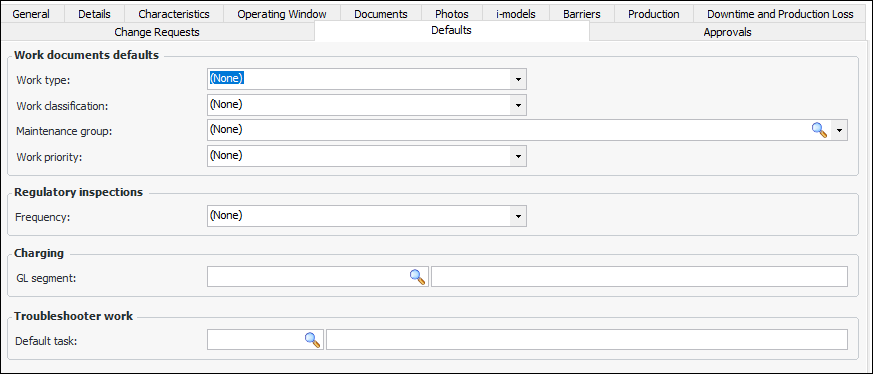
Select the Defaults tab to choose default selections for the asset’s work documents, regulatory inspections, and so on.
 
17.
18.
Select the Approvals tab to view and select approval routes for the asset and to view which documents require approval for the asset.
Now that you have completed the general properties of the asset, you can perform other tasks. Refer to the following topics:
When you are finished, save the new asset and close the Asset window.