Creating an Asset Group

Asset groups are used to collect similar assets to make it easier to search for them or to compare data on similar assets. For example, you might want to group all 100 hp motors.
If your organization uses assemblies with components and component locations, you can set up an asset group for spare component assets. The “Spare” asset group will provide a parent asset for components that are not currently installed in a component location.

To Create an Asset Group

1.
From the Site window, select the Assets view and then the Physical Hierarchy tab.
2.
Tip: When you create assets from the hierarchy, APM automatically fills in the parent information. You can also add assets from the Listing tab by clicking New. With this method, you must add the parent asset information.
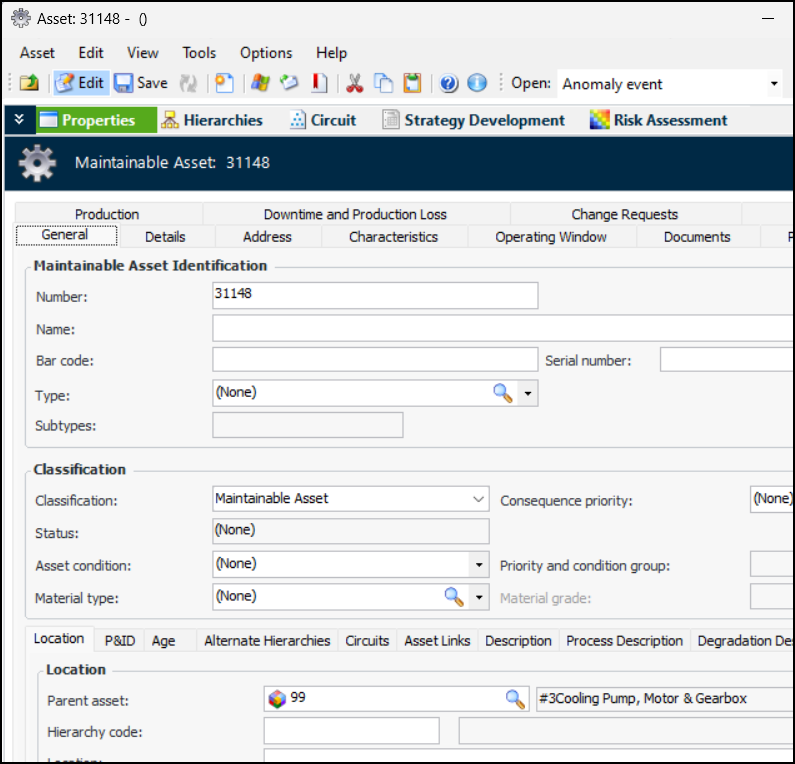
The Asset window opens, showing the Properties view, General tab. For example:
Note: The CMMS tab appears in the Asset window when the Work Management Integration module is licensed and activated. For information, see the guide for the APM CMMS Integration plug-in you are using.
3.
On the General tab, identify the asset:
Note: When the type is selected for an asset, the number of tabs displayed changes based on the type’s settings and classification. For example, for asset groups, you need only fill in minimal information, whereas for maintainable assets, you will need to provide more information.
A tab for each subtype is added to the asset’s Properties view, where you can enter additional information about the asset.
4.
In the Classification area, provide the following information:
5.
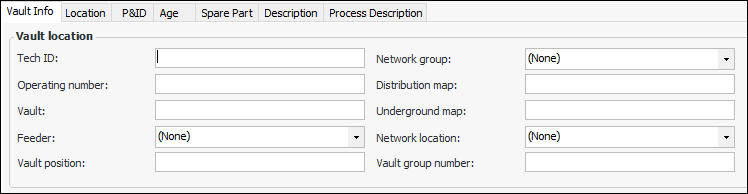
The Vault Info tab is available if the asset type is for electricity transmission and distribution networks. For example:
6.
On the Location tab, enter the following information:
Tip: You can click the browse icon and point to the location on a map to have APM assign the coordinates. For more information, see Setting Map Coordinates.
7.
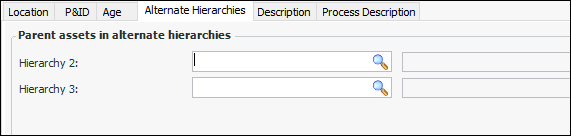
If you are using additional hierarchies, you can select the Alternate Hierarchies tab to establish the new asset’s position in it. This tab lists all of the hierarchies defined for the enterprise. For example:
Click a browse icon to select the parent asset in the alternate hierarchy.
8.
Select the Description tab to add general information about the asset.
9.
Select the Process Description tab to describe the process taking place in the asset. For example, enter a degradation-focused summary of the movement of fluid through a corrosion loop.
10.
11.
Select the Documents tab to add standard documents. For more information, see Adding Documents to an Asset.
12.
Select the Photos tab and then click Browse to select inspection photos to be included with this asset.
13.
Click Open Folder to view the location.
Tip: You can also drag and drop photo files into the table.
14.
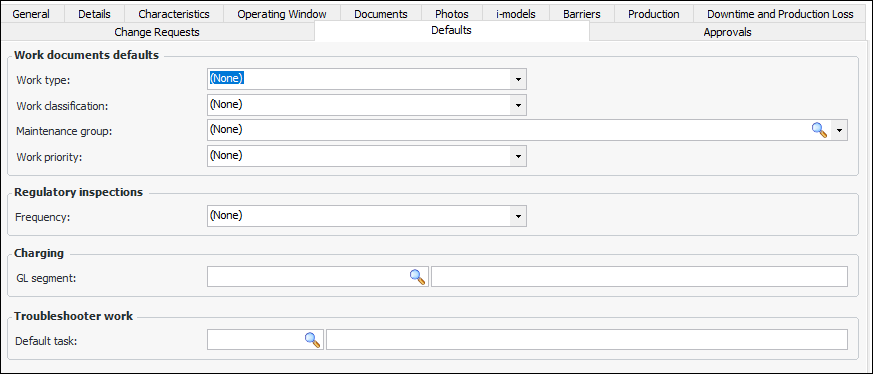
Select the Defaults tab to choose default selections for the asset’s work documents, regulatory inspections, and so on.
 
15.
16.
Select the Approvals tab to view and select approval routes for the asset and to view which documents require approval for the asset.