Adding Services to a Standard Task

This section explains how to add service requirements to a standard task.
You can specify which service resource is required and the number of units required or, for time-based services, the amount of time for which the service is required. You can also specify any lag time that is needed for each requirement.

Overriding GL Accounts

APM automatically derives a GL account for charges to an asset or work order task based on the site’s accounting settings. You can override the derived maintenance GL account for labor, direct purchases, and inventory usage charged to an asset or work order. When the account number is overridden, the replacement account number is used on subsequent documents and transactions (work order requirements, timecards, issue transactions, purchase order lines, and receipts). The option to override a GL account is available only if the work type has been set up to allow the override.

To Add a Service Requirement to a Standard Task

1.
2.
3.
Select the Planning tab. This tab shows the planning information for the task, as well as a list of trades, materials, tools, and services currently selected for the task.
Note: By default, APM calculates the estimated duration of the task based on the time requirements for labor, tools, and time-based service requirements. To provide the estimated duration manually, clear the Calculate options and enter the value in the Estimated duration boxes.
4.
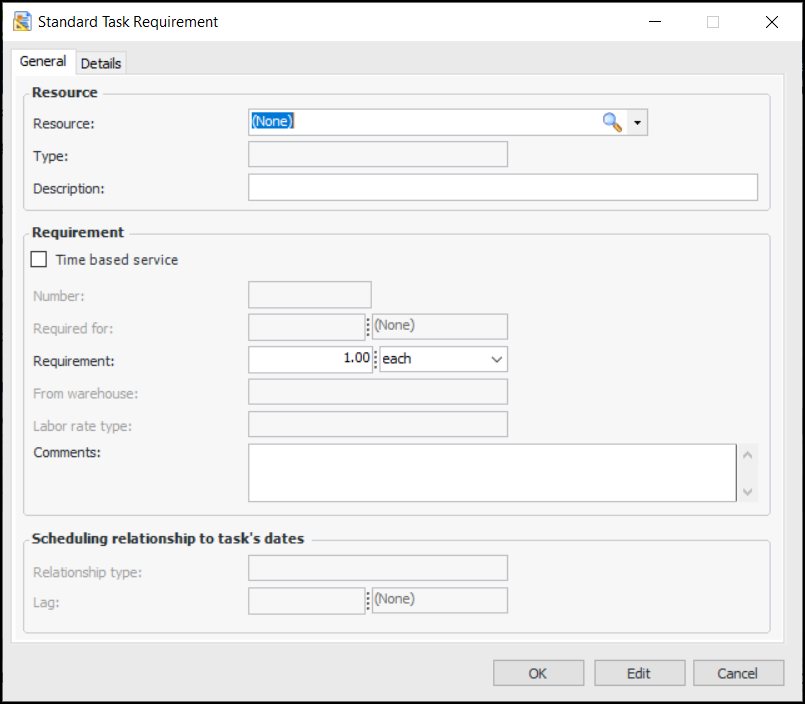
Select the Services tab and click New. The Standard Task Requirement dialog appears.
5.
On the General tab, enter the following:
The total number of items that are required. For example, the number of employees or contractors required for the trade or the number of tools.
The amount of time that each service is required. For example, enter how long each worker will need to work on this task. The total time entered for the requirement will be calculated as:
Number Of x Required For
Number of x Required for
Start to start (SS): The requirement starts when the task is planned to start, offset by any entered lag time.
Finish to finish (FF): The requirement ends when the task is planned to end. The system automatically calculates the required lag time.
6.
Select the Details tab, and enter any necessary charging info and approval settings:
If you select the option The approval route will be identified when the work order is sent for approval, users will be able to choose from a list of appropriate route.
7.
8.