Adding Job Contractors to a Work Order Task

This section explains how to add requirements for job contractors to a work order task. You can specify which trades are required to work on a work order task, how many contractors are required for each trade, and the number of hours they are required for. If necessary, you can also set lag times for each contractor requirement.
You may know in advance that the work order will require a job contractor resource. Or, you can plan the trade as an internal (employee) requirement, and later change it to a purchase (job contractor) requirement if necessary. To add a requirement for internal employees or for on-site contractors, see Adding Trades to a Work Order Task.
Alternatively, you can plan a service requirement on the task. Service requirements are created based on service resources listed in the resource catalog. Job contractor requirements are based on trades, which are listed in the site’s Personnel view.
The main difference between services and job contractors (trades) is that services can use both time- and non-time-based units of measurement (for example, an oil analysis service), while job contractors can only use time-based units of measurement (for example, hours or days). Both job contractors and time-based service requirements can be added to availability schedules.
To add a service requirement, see Adding Services to a Work Order Task.
Note: If the work order has already been approved or marked as planned, you will not be able to add requirements to it. To add requirements to a planned work order, you must first redraft it.

Overriding GL Accounts

APM automatically derives a GL account for charges to an asset or work order task based on the site’s accounting settings. You can override the derived maintenance GL account for labor, direct purchases, and inventory usage charged to an asset or work order. When the account number is overridden, the replacement account number is used on subsequent documents and transactions (work order requirements, timecards, issue transactions, purchase order lines, and receipts). The option to override a GL account is available only if the work type has been set up to allow the override.

To Add Job Contractor Requirements to a Work Order Task

1.
2.
3.
On the Planning view, select the Planning tab and then the All Requirements tab. This tab shows the planning information for the task, as well as a list of trades, materials, tools, and services currently selected for the task.
4.
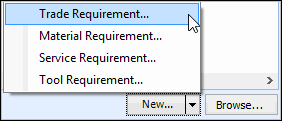
Click the down-arrow beside the New button, and select Trade Requirement.
Tip: You can also select the Labor tab to view all labor requirements for the work order task, and then click New.
Tip: To add several different requirements at once, click Browse. The Browse Catalog dialog appears. Each tab on this dialog lists different types of resources that you can choose. On the Resources tab, select the Resource type to switch between materials, tools, trades, and services. Select the check boxes for each resource that you want to add. You can select resources on more than one tab. When you are finished, click OK.
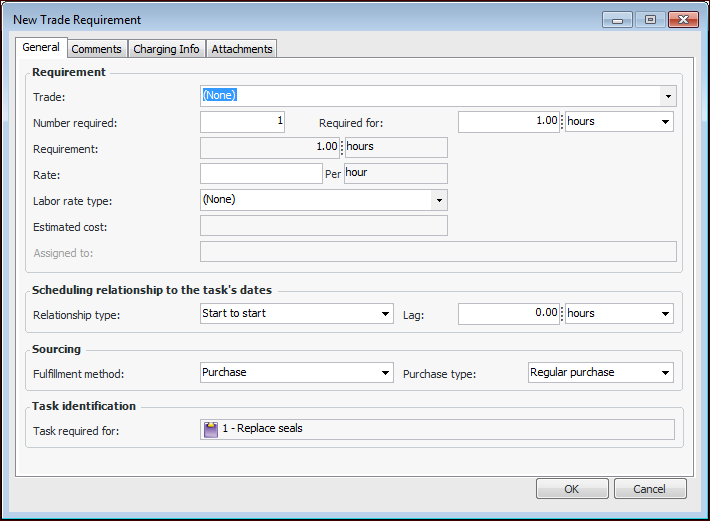
The New Trade Requirement dialog appears.
5.
On the General tab, enter the following:
Select the appropriate trade from the list. Job contractor trades must have Purchasing or Purchasing and maintenance set as the Available source on the trade resource.
The amount of time that each employee, contractor, tool, or service person is required. For example if you are entering a trade requirement, enter how long each employee will need to work on this task. The total time entered for the requirement will be calculated as:
Number Of x Required For
The name of the employee or contractor assigned to this trade requirement.
You will only be able to assign someone to the requirement if the entry in the Number required box is “1”. You cannot assign multiple people to a single trade requirement. To assign multiple people, you must create multiple trade requirements (each with the Number required set to “1”).
Start to start (SS): The requirement starts when the task is planned to start, offset by any entered lag time.
Finish to finish (FF): The requirement ends when the task is planned to end. The system automatically calculates the required lag time.
Select Service order.
6.
Select the Purchasing tab. Enter the following information:
By default, the system enters the default supplier of the resource. If necessary, you can change the supplier by clicking either All Suppliers or Valid Suppliers and selecting a new supplier from the selection dialog.
7.
Select the Comments tab to enter your notes. For requirements that must be purchased, you can also add instructions in the Purchasing description box. This information is copied to subsequent documents in the purchasing flow, for example, the purchase order line created from the work order task.
8.
To override the GL account or cost type, select the Charging Info tab and make the appropriate changes (only available if overrides are allowed for the task’s work type).
9.
Click OK to save the requirement and close the dialog.
10.
Select the Labor tab. The system selects the first trade added as the Primary Trade for the task. If necessary, you can select a different trade as the primary trade. This reference allows you to sort and filter lists of tasks by primary trade.
11.