
Introduction to APM with AWEIS

Bentley AssetWise Enterprise Interoperability Service (AWEIS) connects applications in a loosely coupled, services-oriented architecture. Bentley offers it as part of its cloud-based CONNECT services platform, providing Interoperability as a Service (IaaS) to facilitate exchanges between Bentley software products and between Bentley and third-party software solutions. Bentley’s interoperability offering addresses the needs of modern software deployment architectures, supporting cloud-hosted, standalone, and/or hybrid topologies.
When APM has been configured to work with AWEIS to exchange data with your CMMS (for example, SAP), the CMMS is the master system where assets, work documents, employees, and maintenance groups are maintained. APM is the system for inspection management, strategy development, and performance tracking.
This overview looks at the integration points between APM and the CMMS, using examples from SAP Plant Maintenance.
If you are using APM construction management functionality to identify assets that are being installed in the field and to perform installation inspections, AWEIS makes it possible to use asset change requests and to generate inspection tasks from construction forms. For more information, see Introduction to Construction Management.
APM can be configured to integrate with an external Anomaly Assessment and Tracking (AA&T) system. With the help of AWEIS and other middleware, anomaly events are sent to the AA&T system, which then becomes the master system for the anomaly events. Information, including event statuses, is sent to the anomaly event in APM to keep the two systems synchronized.
When the integration has been set up, you can perform risk assessment when acknowledging indicator alarms or creating requests for work. The resulting criticality is added to the new anomaly event and used to determine if the anomaly is actionable. Actionable events are sent to the AA&T system for the creation of notifications, which are then sent on to the CMMS (SAP) to generate maintenance orders.
For more information, see Anomaly Risk Assessment and Integration.

Integration Points

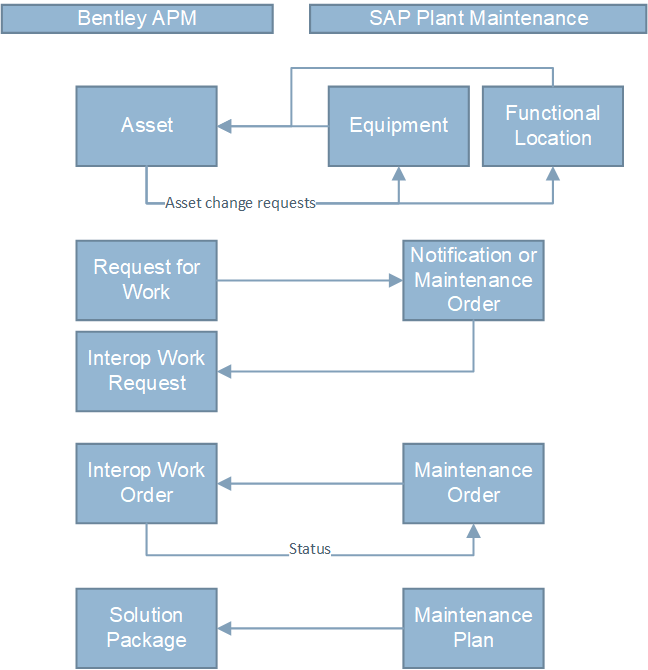
The following diagram shows integration points between APM and SAP Plant Maintenance.

Synchronize Asset Data

During the implementation project, CMMS assets (for example, SAP equipment and functional locations) are imported as new assets into APM. In addition, the characteristics feature makes it possible to import asset characteristics from the CMMS and to map characteristic values to APM asset properties. Interoperability processes communicate information about new and updated CMMS assets to APM, ensuring that asset information remains synchronized.
Construction forms add new APM assets that have been purchased and delivered to the job site for installation. They also record existing assets to be installed at the location. New, updated, and removed assets are communicated to the CMMS using asset change requests. The data includes asset characteristics (specifications), hierarchy information, and asset statuses for the corresponding CMMS equipment.
When information about new or updated assets is sent to the CMMS, the CMMS asset record is created or modified. Information such as the equipment number is sent back and recorded on the asset in APM.

APM-Only Assets

You can create APM-only assets when AWEIS is active. An APM-only asset is one that was created in APM and does not have a corresponding asset in the CMMS.
All standard APM functions can be performed on APM-only assets, including:
You can assign APM-only assets to requests for work. However, the APM-only asset must be a child of an interop asset (an asset with a corresponding CMMS asset). When the request for work is submitted, APM first determines whether the asset originated in the CMMS or in APM. For an APM-only asset, the system traverses up the asset hierarchy until it finds an interop asset, which is then referenced by the request (this is the asset that is updated in the CMMS).
If APM cannot find an ancestor interop asset, it returns an error message explaining why the request for work cannot be submitted.
Tip: You can see which of the assets on a site originate in the CMMS and which are APM-only by adding the “AssetWise Interoperability Active” column to a table configuration that lists assets. CMMS assets are shown as “Active”. For more information, see Adding and Removing Columns in a Table Configuration.

Requests for Work, Notifications, and Interop Work Requests

Requests for work are created in APM, for example, through alarm acknowledgments, and sent to the CMMS for the creation of notifications and maintenance orders (in the case of SAP). The request can reference CMMS preplanned work (such as a solution package) to modify the next date on the corresponding maintenance plan.
New notifications and changes are sent from the CMMS to APM, where corresponding interop work requests are created or updated.

SAP Maintenance Orders and Interop Work Orders

In this interoperability example, maintenance orders that are created and updated in SAP are sent to APM, where simple interop work orders are created and managed. When a work order is sent from SAP that references a solution package and cycle, the linked standard tasks are used to create a set of inspection checksheets on the work order.

SAP Maintenance Plans and Solution Packages

In this interoperability example, maintenance plan information is sent from SAP to APM in the form of solution packages that represent preplanned work. The solution package includes information such as job number, description, priority, work type, work classification, and maintenance group.
In APM, an administrator creates solution package templates and links them and cycles to standard tasks in the asset program profiles that APM uses to generate inspection activities for a construction form.
This mechanism allows for a loose coupling between the SAP maintenance plan and the APM solution package. The schedule and work cycles are controlled in SAP, but the details of the corresponding inspections are maintained in APM and are linked through the solution package.
SAP is the master system for solution packages and will send updates any time that there is a change to the mapped data in the maintenance plan.

Site Integration Between APM and CMMS Instances
APM and AWEIS support the integration of two or more instances of a CMMS (such as SAP Plant Maintenance) with sites in a single APM database. For example, a facility, factory, or plant in SAP could exchange data with its corresponding site in APM.
To support the integration, you can maintain site-specific value lists in APM, along with site type settings that control which sites own employees and trade resources. You must also create AssetWise Interoperability systems for each CMMS instance and link the systems to their corresponding sites in APM.
For information about typical configurations and setup steps, see Setting up Site Integration Between APM and CMMS Instances.