
Creating a Failure to Acknowledge an Alarm with AWEIS

When failure tracking is set up in your APM environment, you will typically create or link to failure records when acknowledging an indicator alarm with one of these methods:
The request for work is available instead of APM work documents when APM uses AssetWise Enterprise Interoperability (AWEIS) to exchange data with an external CMMS. The site’s interoperability profile specifies whether APM or interop documents are in use.
In the Acknowledge Indicator Alarm dialog, the Failure tab is available when the Create or link to a failure record option is selected on the Acknowledgment tab. This option is selected by default when the site’s indicator state default settings and the indicator state settings specify that failure records be created for alarm acknowledgments. You can change the default values when creating the acknowledgment.
The failure record is created for the indicator’s asset. The source of the failure is defined as Indicator alarm acknowledgment. The status of the failure is Open unless the alarm is acknowledged as “fixed during inspection”.
If the problem was fixed during inspection, the failure’s status is Resolved. The Resolved on and Returned to service on dates are set to the date and time that the alarm was acknowledged. The Resolved by value is the employee who acknowledged the alarm. The resolution description is populated with the collector’s note from the indicator reading.
Note: After saving a failure record, you must use the Change buttons or the commands on the Tools menu if you wish to change the following information: asset information (including failure codes), failure dates, severity level, PF interval. You cannot simply enable editing to change this information because the failure statistics for all affected assets might require recalculation. For more information, see Editing Failure Records.
This topic explains how to create a failure record when acknowledging an alarm.

To Create a Failure When Acknowledging an Alarm
1.
On the Acknowledge Indicator Alarm dialog, Acknowledgment tab, select one of the following methods, as appropriate:
2.
Ensure that Create or link to a failure record is selected.
For information about completing the Acknowledgment tab, see Acknowledging Indicator Alarms with AWEIS.
3.
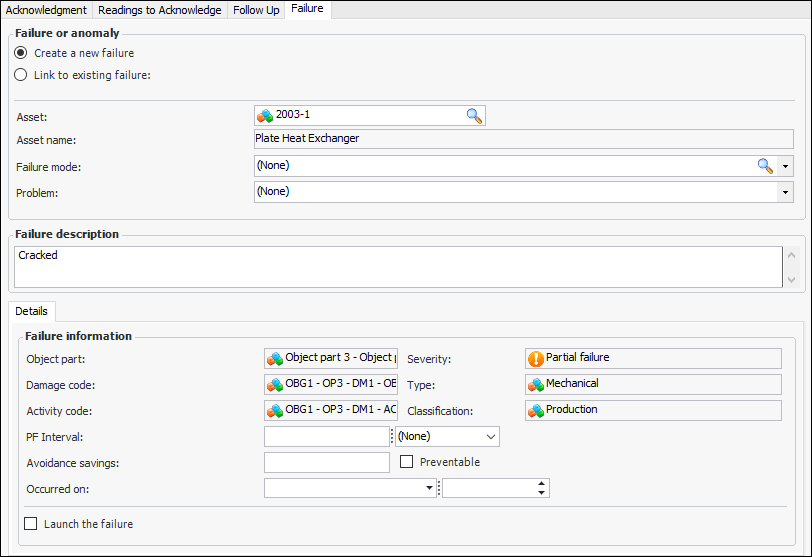
Select the Failure tab. Here is an example when object part, damage code, and activity code are in use:
In the Failure information area, the failure codes are copied from the primary event defined in the acknowledgment. The severity, type, and classification are copied from the event’s damage code.
Note: If two or more events have been defined on the acknowledgment, and the same damage code is used in two or more of the events, and the damage code specifies that failure records are created for all events to which it is assigned, then secondary failures will be created for the acknowledgment. Only the primary failure (with the highest priority) is shown on the Failure tab.
4.
Select either Create a new failure or Link to existing failure.
5.
If you selected Link to existing failure, browse to select a failure from the Failure Selector dialog and then skip to step 13.
6.
If you selected Create a new failure, you can select a failure mode or problem:
If problems have been defined for the asset type, select a suitable problem from the Problem list. Information from the selected problem is copied to the failure record.
7.
The Failure description box contains the indicator state’s name. You can change and add information to the description.
8.
The default PF interval is based on the settings of the indicator state and alarm type. For example, it can be copied from the selected failure mode, specified on the indicator state, or calculated based on the alarm type’s rule. The default value can be adjusted to reflect your best guess for the time that elapsed from when the failure started to be noticeable to the time when the reading was taken.
For example, an indicator state has a PF interval of four months (120 days). The indicator is read at a frequency of every 60 days. When a failure is created from the indicator and state, the PF interval on the failure is prompted with a value of four months. Because the reading value indicates that the failure started to occur 20 days ago, you could manually adjust the PF interval to 100 days.
9.
10.
Select Preventable if you wish to indicate that the asset’s reliability program needs review.
11.
12.
13.
Click OK. APM closes the dialog, creates the work document (if selected), creates the failure record, and turns off the warning or alarm on the indicator.
A downtime incident is also created if the indicator state’s failure settings specify it. You can select the asset’s Performance Management view, Downtime tab to review the incident.
Tip: If secondary failures were created, you can view them in the Failure or anomaly window, Properties tab, Related Failures tab.
When tracking a failure record, you can also perform the following tasks: