Asset Reliability Process

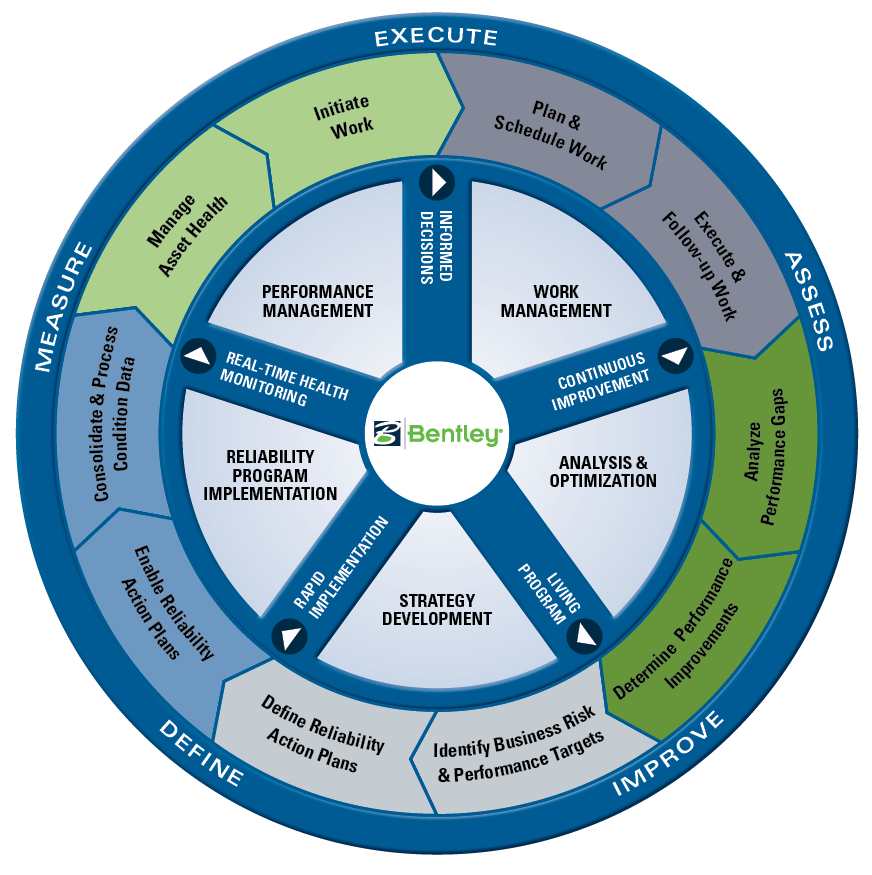
The Bentley APM reliability process is a comprehensive cycle made up of the stages and activities required to effectively manage asset performance. The cycle is a continuous process of performance tracking and program optimization throughout the operating life of an asset. The asset care program must keep pace with changes in the market and stakeholder expectations. In addition, the overall capability of the asset might degrade with use, affecting the asset’s ability to meet current and future needs. Therefore, asset capability and business requirements must be periodically evaluated, and the maintenance and reliability programs must be adjusted accordingly to provide optimal performance at minimum cost.
To do this, the APM process includes the development, implementation, deployment, and execution of proactive strategies that focus on doing the right work at the right time. The execution of new strategies is supported through the collection and interpretation of Key Performance Indicator (KPI) data from sources across the enterprise. Asset life cycle data is also taken into account. The data is consolidated, quantified, and qualified to provide indications of asset health and impending failure events. Single or multiple calculations are run to assess asset health and determine the best course of action in time to plan and schedule an inspection and/or corrective procedure. The consolidation of asset performance information through real-time condition monitoring is critical to the development of asset maintenance programs that help operators, maintainers, and managers pro-actively plan and schedule work.
The APM process also recognizes that, although a program might be predominantly proactive, failures still occur. These failure events must be analyzed to determine their root cause and dominant failure patterns so that the asset management program can be updated to provide optimal performance at minimum cost. Other factors that influence asset performance can likewise be optimized using historical data to improve asset life cycle costs, spare part management, and predictive and preventive maintenance strategies and frequencies. The APM process provides a living model to define and implement proactive, data-driven asset management for all capital intensive operations.
The APM process comprises five stages: strategy development, reliability program implementation, performance management, work management, and analysis and optimization. The APM wheel shows stages and their business processes:

Strategy Development

Identify Business Risks and Performance Targets

Identifying business risks involves reviewing business goals to nominate systems and sub-systems for improvement initiatives. Selected assets are critical to business performance and cause the greatest pain.
Asset risk prioritization identifies business risks at the system or sub-system level in terms of safety, environmental, operational, and non-operational consequences. This provides a basis for prioritizing and nominating assets for performance improvement initiatives such as RCM2, RBI, MTA2, RCA, and capital projects.
Performance targets are specific asset business objectives or key performance indicators (KPIs). These include Overall Equipment Effectiveness (OEE), availability, throughput, asset utilization, quality loss reduction, failure avoidance, and failure reduction.

Define Reliability Action Plans

Action plans are the output of the various strategy development methodologies. These methods include:
Action plans identify the recommended action to follow based on the analysis undertaken and are the basis for the implementation of an overall asset management program.

Reliability Program Implementation

Enable Reliability Action Plans

This phase refers to the implementation and ongoing execution of action plans and program recommendations. The implementation of action plans includes the development and execution of condition-based maintenance (CBM), predictive maintenance (PdM), and preventive maintenance (PM) routes, as well as the design and the management of program changes such as physical redesign recommendations, procedure modifications, and training opportunities.
The process of enabling action plans includes the detailed development of condition-based indicators, their potential collection values, and the individual alarm state that is identified by each abnormal value. Once these indicators are identified, they are packaged into routes and check sheets that are organized by frequency and the groups who collect the data. At this time, complex calculations or rule-based indicators can also be developed to manage potential failures that become evident with multiple data inputs. In conjunction with CBM activities, scheduled restoration and replacement tasks must be fully defined and made ready for the planning function. Online data collection systems are identified and tagged as part of this stage, along with deployment of mobile data collection devices and paper check sheets.

Consolidate and Process Condition Data

Data is consolidated from various sources, including mobile data loggers, CMMS/EAM/ERP databases, data historians, and online and real-time data sources. This data is used by asset health and asset performance indicators.

Performance Management

Manage Asset Health

This phase refers to the management of on-condition alarms that exceed defined threshold values and that indicate potential failures. These alarms are pro-actively identified, acknowledged, and managed to maintain overall asset health and performance.

Initiate Work

Work can be automatically triggered from condition-based alarms, or it can be calendar- or meter-based. The manual creation of work requests and work orders by the asset stakeholders is also included as part of work initiation. This can include demand work, project work, condition-based maintenance repairs and refurbishments, and preventative and predictive maintenance tasks.

Safety Management

APM safety management functionality helps organizations analyze and monitor equipment systems and processes with the goal of protecting the health and safety of their workforces, local communities, and the environment. It is designed to help companies remain compliant with current local, national, and regional legislation, as well as industry best practices. APM provides these safety management objects:

Work Management

Plan and Schedule Work

Planning identifies job and task procedures, labor and materials requirements, special equipment and tools, as well as safety, environmental, and operational requirements, permits, and so on.
Scheduling involves compiling, prioritizing, and scheduling planned work packages with operations and maintenance groups.

Execute and Follow Up Work

Work is executed and supervised. Follow-up activities can identify procedure and planning changes, as well as corrective work based on condition inspections and PM work.

Analysis and Optimization

Analyze Performance Gaps

Downtime and failures are tracked against defined performance targets. This phase includes the analysis of failure events using Root Cause Analysis (RCA) and techniques such as Weibull analysis. The further analysis of mean time between failure (MTBF) and mean time to repair (MTTR) data can be used to recommend changes to the asset management program.

Determine Performance Improvements

All of the recommendations from RCM2, RBI, MTA2, RCA, Weibull, and other analyses provide recommendations for improvements. This stage references the decision process for determining which of the recommendations are accepted and which are not. In some instances, the result might be to change the asset performance targets. This step “closes the loop” to drive sustainable results and continuous improvement in the face of changing business conditions.